





Devil’s Edge – Damascus Qama / Kindjal
In stock
$99.99
- Shipping estimated at checkout
- Every blade inspected before shipping
- 30-day returns
- Class
- Battle Ready
- Blade
- Damascus Steel
- Overall Length
- 23''
- Weight
- 1 lb 10.9 oz
- Brand
- Devil's Edge
- Culture
- Arab
- Era
- 19th Century
Overview
Devil's Edge - Damascus Qama / Kindjal
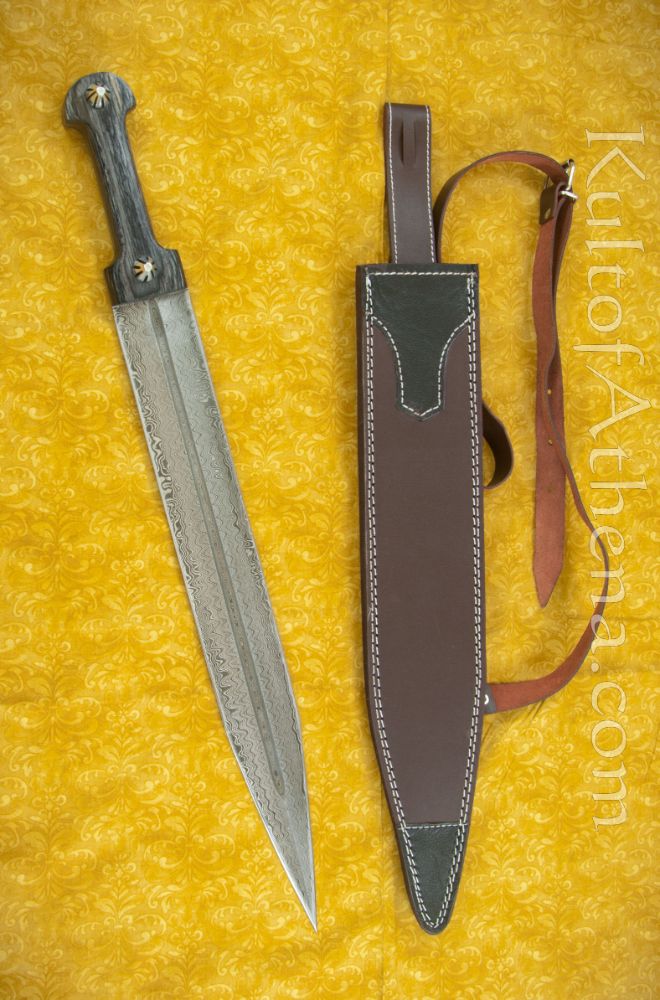
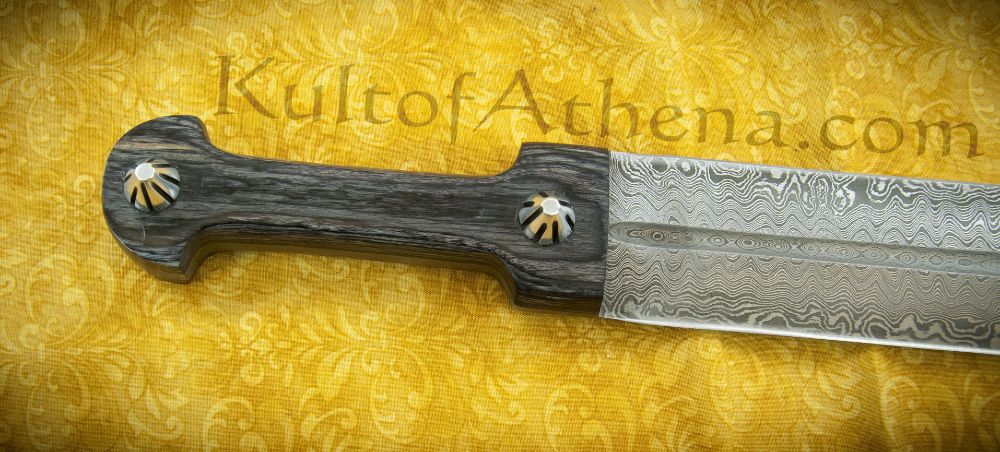
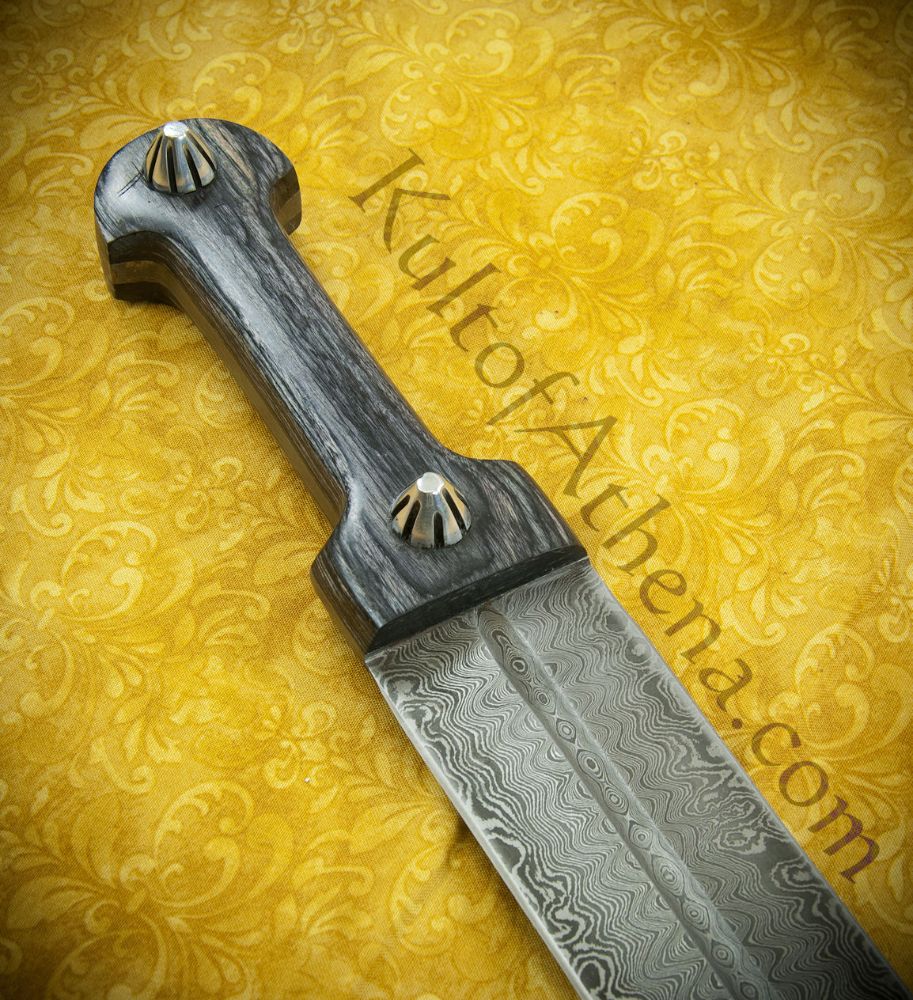
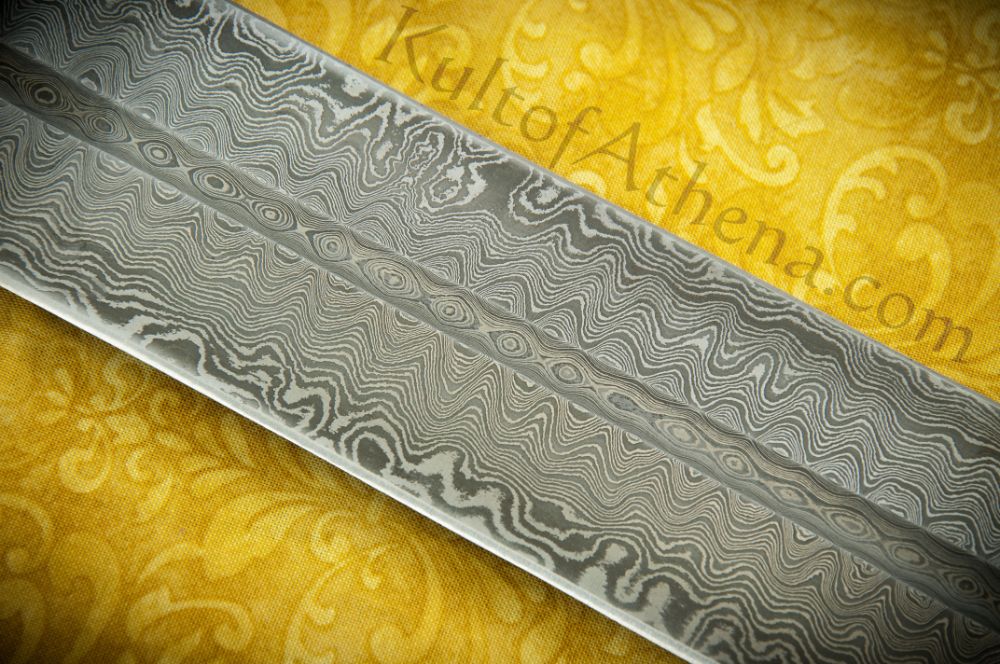
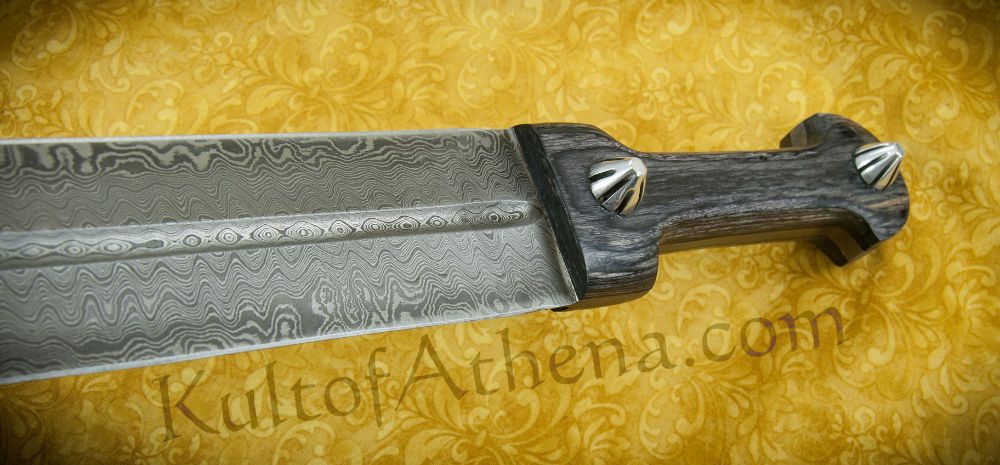
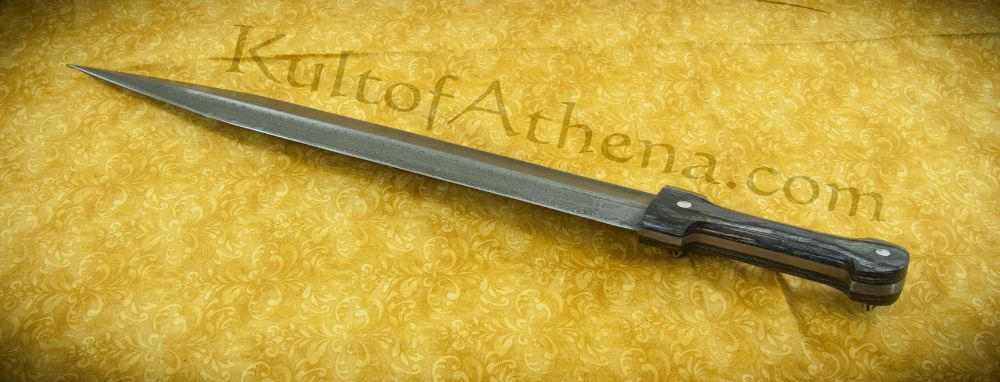
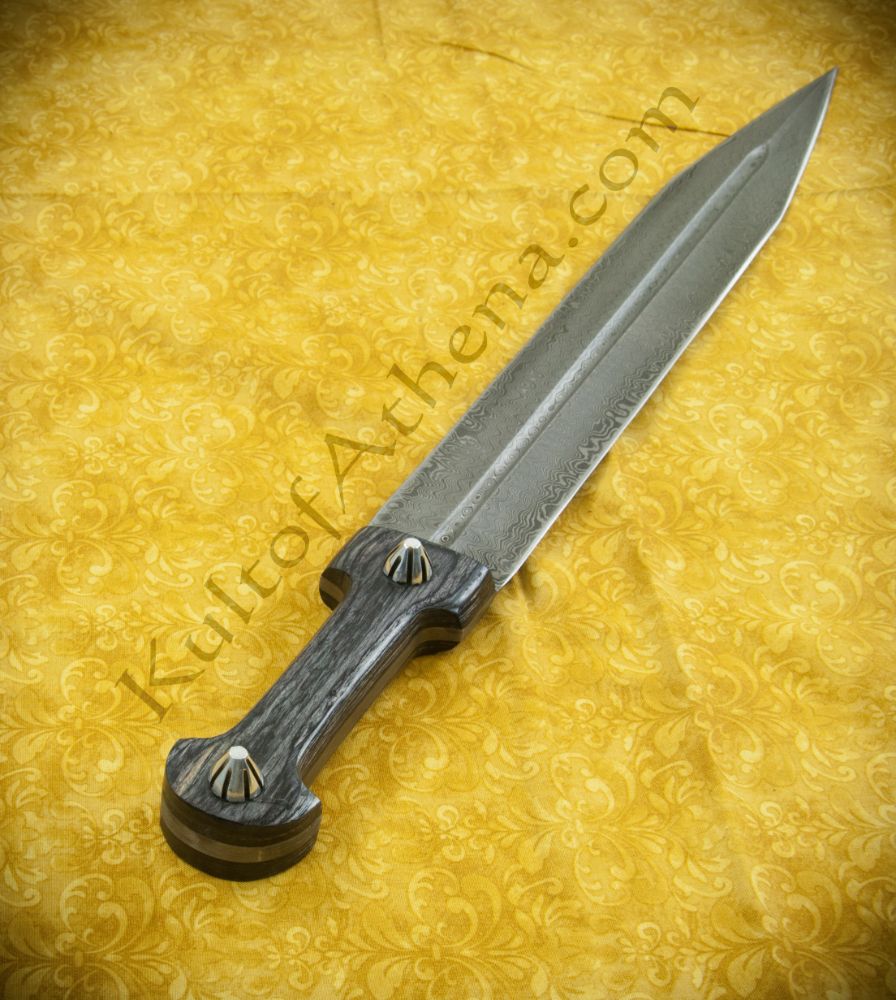
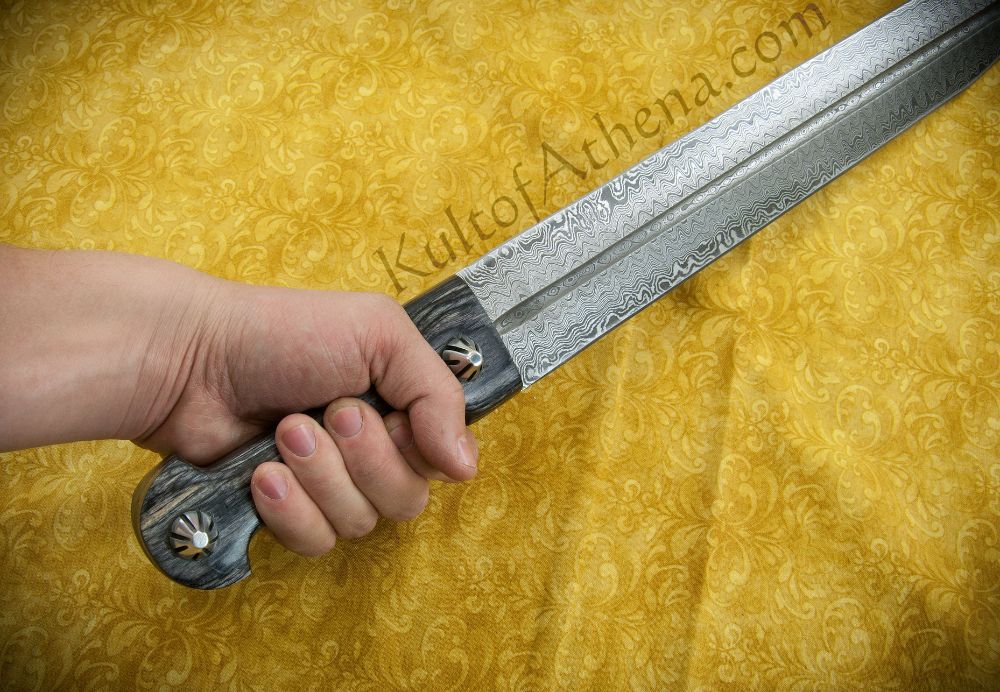
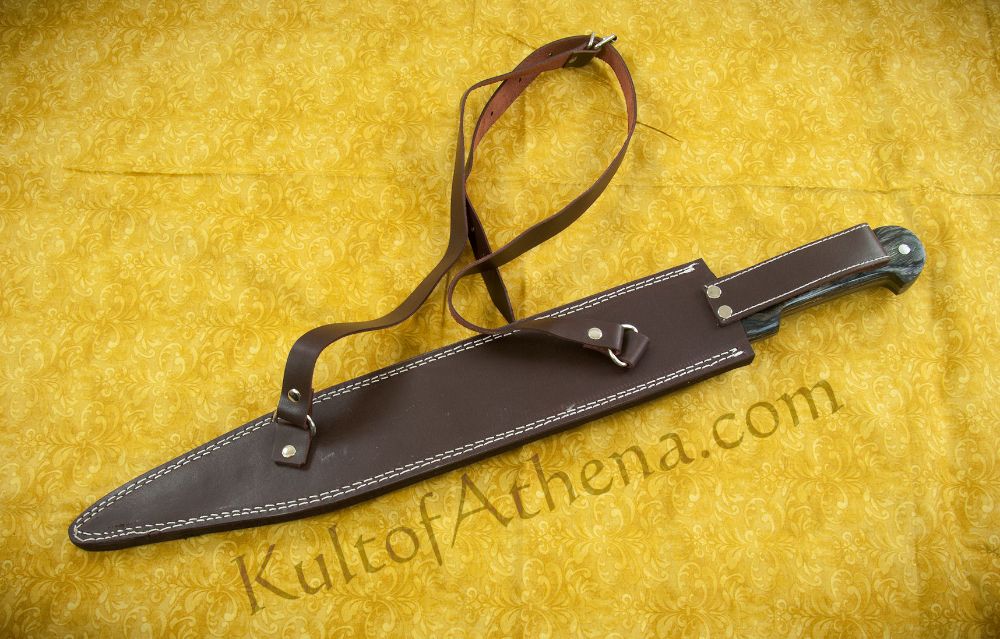
This Qama / Kindjal has a double-edged blade of sharpened damascus steel; the blade is embellished with the vibrant, swirling designs of mixed steels in the layered damascus blade. These patterns were created when the smith worked two differing types of steel into a single billet before forging it together into a single, double-edged blade. The hilt is crafted by merging two carved and polished halves of wood with the thick blade tang with a pair of steel rivets topped with conical steel studs. The hilt of this Qama is slightly longer than other production Qama on the market, making it easier to grip in the hammer fashion. The sword is paired with a scabbard of sturdy, stitched leather with a belt loop and adjustable baldric strap.
An iconic weapon of the Caucasus region, the Qama / straight Kindjal was used by cultures as far-reaching as Georgia and Persia, as well as Russia and the Caucasus. Circassians, Cossacks and Persian tribesmen alike all wore the Qama as a weapon of personal self defense and many were highly embellished to reflect status. Being a weapon associated with Persia and the trade between Persia and India in steel and arms, many Kindjal and Qama had blades of wootz steel, the process of its creation created patterns of watered steel similar in appearance to damascus steel.
Specifications
Every measurement that matters
- Brand
- Devil's Edge
- Culture
- Arab
- Era
- 19th Century
- Pommel
- Integrated
- Overall Length
- 23''
- Blade Length
- 17 3/8''
- Blade
- Damascus Steel
- Weight
- 1 lb 10.9 oz
- Edge
- Sharp
- P.O.B.
- 3 1/2''
- Thickness
- 5.4 mm - 2.8 mm
- Width
- 51.1 mm
- Grip Length
- 3 3/8''
- Class
- Battle Ready
- Country of Origin
- Pakistan
Reviews
What collectors are saying
Q&A
Questions from the community
Q What is the Qama / Kindjal and what is it best suited for? Common Question
This is a double-edged Qama / Kindjal, a traditional dagger-sword of the Caucasus region carried by Circassians, Cossacks, and Persian tribesmen for personal defense. With a sharp damascus steel edge and solid riveted construction, it's built for both display and light cutting work, such as tatami mats or water bottles, as well as historical reenactment.
Q What is the blade made of, and why does it have that wavy pattern? Common Question
The blade is forged from damascus steel, made by working two different types of steel into a single billet before forging them into the finished double-edged blade. The swirling, layered pattern you see is the visual result of that process, similar in appearance to the watered steel historically used in Persian wootz blades.
Q Is the tang full length, and is the handle construction sturdy? Common Question
The hilt is built around a thick tang that runs the length of the grip, sandwiched between two carved and polished wood scales and secured with a pair of steel rivets topped with conical studs. This scale-and-rivet construction is typical of dagger-style fighting pieces like the Qama and holds up well to regular handling and use.
Q Where does this sword balance, and what does that mean for handling? Common Question
The point of balance sits about 3 1/2 inches from the guard, keeping the weight close to the hand. That makes for a lively, maneuverable blade suited to the quick thrusting and slashing motions the Qama was historically used for.
Q Does it come with a sheath, and what is it made of? Common Question
Yes, it includes a scabbard of sturdy, stitched leather with a belt loop and an adjustable baldric strap for carry. For long-term storage, it's better to keep the blade out of the scabbard, since leather can trap moisture against the steel.
Q How should I care for the blade? Common Question
Wipe the damascus steel blade down after handling, apply a light coat of oil to prevent rust, and store it in a dry place outside the leather scabbard. Since the edge ships sharp, handle it the way you would any live blade and keep it away from moisture-prone storage.
Q Is the edge sharp, and is this a functional piece? Common Question
Yes, the edge is sharp, and the piece is classed as battle ready. It's built with full functional intent rather than as a wall-hanger, though as with any sharp blade, care should be taken in handling.
Q Where is this piece made? Common Question
This Qama / Kindjal is made in Pakistan.
Video
See it in motion
Kult of Athena Blade Review Qama Cut testing
The Maker
Devil's Edge
Devil’s Edge develops high quality blades in conjunction with the Kult of Athena. Working in High Carbon, Damascus and high quality 420 Stainless Steels, Devil’s Edge delivers a high level of attention to detail; this forge is not to be mistaken for low quality, stainless steel, wall hangers. Steel type is clearly called out in the product description. Check out this video of 420 stainless at work!
Often paired together

I purchased this sword to accessorize a Renaissance Faire outfit that I have and I wanted to share my experience with it.
It’s a very sturdy blade with little flexibility, definitely a thruster. It can certainly cut/chop as well, the point of balance is several inches forward of the grip and the fairly short, stout blade concentrates force well. The sword came plenty sharp, it could cut printer paper easily, but it wasn’t quite sharp enough to cut receipt paper. The grinds are even and clean, and the point is *very* pointy. The Damascus steel is beautiful and matches the “magical” look I wanted out of this sword.
The grip is the weakest part of the sword, in my opinion. The gray laminate looks nice and the conical studs don’t get in the way, but the edges aren’t completely even, the edges are also squared off and somewhat uncomfortable in some grip positions. I’m not sure how the grip scales are attached to the blade, but they have not loosened after light cutting and chopping tests.
The sheath is basic, but it serves the purpose of holding the sword and securing it safely. I do not use the baldric belt that the sword came with, only the belt loop. Retention is medium, the sword won’t slide out on it’s own, but it can be shaken out with little effort. It came with a snap closure that goes around the grip, I recommend using that to help keep the sword in place.
Overall, I’m happy with this purchase, I would recommend this to others looking for a budget friendly short sword. Although I’m using this as a costume piece, I could definitely see this being used for actual short sword tasks.
I bought the standard grade version on 6/18 and it came 7/1, which I am very grateful for. The Damascus swirls are so much more beautiful and prominent than pictures can do justice, and the tang is super thick and heavy enough that the blade is nimble but incredibly strong (in my opinion). I don’t have Tatami to cut, but a few thick gatorade bottles and i found thrusting through them to be a joy. I wasn’t able to cut through them like a full length blade would, but you can literally poke through thick plastic slowly and feel no resistance, like a slice of butter. I would recommend this to anyone who wants a great deal, it’s very strong and the handle is delightfully simple and smooth. 5/5
For the price, it’s a very nice Kinjal, reminiscing a Circassian style of a dagger, though at certain times in history they were popular with a curved balde, as was more of a fashion in the east, but this is a classic, Roman Gladius’ inspired blade, with origins back to the 3rd Century BC, except before widespread usage of steel, they were made with bronze and other alloys.
A symbol of a free-man/woman. Culturally it has a lot of significance, from martial arts to marriage ceremonies. A trusty side-arm along with a saber / Shashka.
Yes, it’s a bit rough around the edges, but overall it is quite sharp and symmetrical. I would imagine it looks and functions better than a lot of the actual historical examples survived to this day, due to the advanced modern metallurgy and machining. In fact, a bit of mild asymmetry in places makes it look more like a hand-made piece, which I, personally, appreciate. A great match for a Cossack/Circassian-Adyge and Caucasus Region’s tribes’ costumes. Though Kinjal was popular in Ancient Rus’ & Tsarist Rus’, and outside of the Caucasus Region, too, for many centuries.
The sheath is part real leather, part synth leather, but dual stitching makes it quite strongly built. If a bit of the white strings used in the stitching is loose — just blast it with a lighter for a moment. The tip of the scabbard came a tiny bit bent, likely from prolonged storage, but it doesn’t affect the performance. The packing itself was impressive though.
The sling that comes with the scabbard is made of real leather. Star motifs on the brass-like studs are nice touches, though stars may be questionable motifs, they are too small to stand out anyway. The buckle is also made to look liked aged brass, but there’s probably way more tin there than copper, it seems sturdy enough for serious wear, the Kinjal being a lighter sword helps (at least dimensions’ wise it seems to be more like a short sword than a dagger). Just please take some time and thoroughly oil both the blade and the scabbard/sling. The leather is very dry and you can prolong its life-span significantly with some oil that doesn’t go rancid. Wood cutting block mixture of microwax and oil, food grade — is a good option. I also used some gun oil. But any oil that doesn’t go rancid will do. If you plan to wear it outside in adverse weather it’s a must. Also pig’s fat was also historically was used to create an environmental shield (as well as lubricate the hinges lol).
The handle is not super-slick and it helps with a grip, without it seeming cracked or having too deep of grains. The stainless steel, I suppose, “knobs” are quite more sturdy than historical copper or brass ones. Of course there were heavily decorated Kinjal made with silver, gold and encrusted gems. This is more of a utilitarian version. And there’s nothing wrong with that.
The “Damascus” steel is quite nice! Which was the biggest positive surprise for me. I expected it being only on the surface, purely decorative in nature. It’s likely forge wielded mid-carbon and higher-carbon steels, and the the visual effect goes beyond the surface, which is very cool. It’s not the most sturdy blade, in comparison with some made from modern alloy steels, but it will do the job just fine. The blade is quite thick and there’s 0 wobble to it, quite stiff, as it’s supposed to be to help with piercing through armor and softer spots of the armor. As I said, even being forge-wielded from two types of mediocre carbon steels, it’s still likely stronger than most survived historical samples, sometimes made from crucible steel, sometimes forge-wielded, but the impurities and the quality overall very much varied from bad to somewhat decent (especially if the steel was imported from India and other regions with advanced metallurgy for the time-period). Modern OK “Damscus” would be better than most average dagger steels of pre-modern history, so no worries about the sturdiness portion.
I, personally, think it’s a great Kinjal for the price, just needs some initial maintenance with oil and wax. It came sharp, but can be made sharper if you hone the blade with a 10,000 grain stone, though it’s only if you plan to practice with it on targets, but even without, it’s still quite sharp. It will also give the edge a nice polished shine. Oil the blade to keep the rust away. Oil it few times, as the inner part of the scabbard is very dry and will “drink” all the initial oil away.
I am happy with the purchase. Yes, it’s a bit rough around the edges, but I’ve seen much worse examples. It’s a good Kinjal for the price. It being “rough around the edges” — is not exactly bad when someone tries to look historically accurate.
sharp yep ,good steal yes & good for the price & survival,
Not much to say other than, absolutely stunning, the damascus pattern is absolutely breath taking, and the sword is surprisingly light. I was expecting something a little more heavy, but nope, easy to hold in one hand. Shipped nicely, well oiled, protected with plastic, and even the scabbard is a nice fit for the blade. I am beyond impressed with this weapon.