
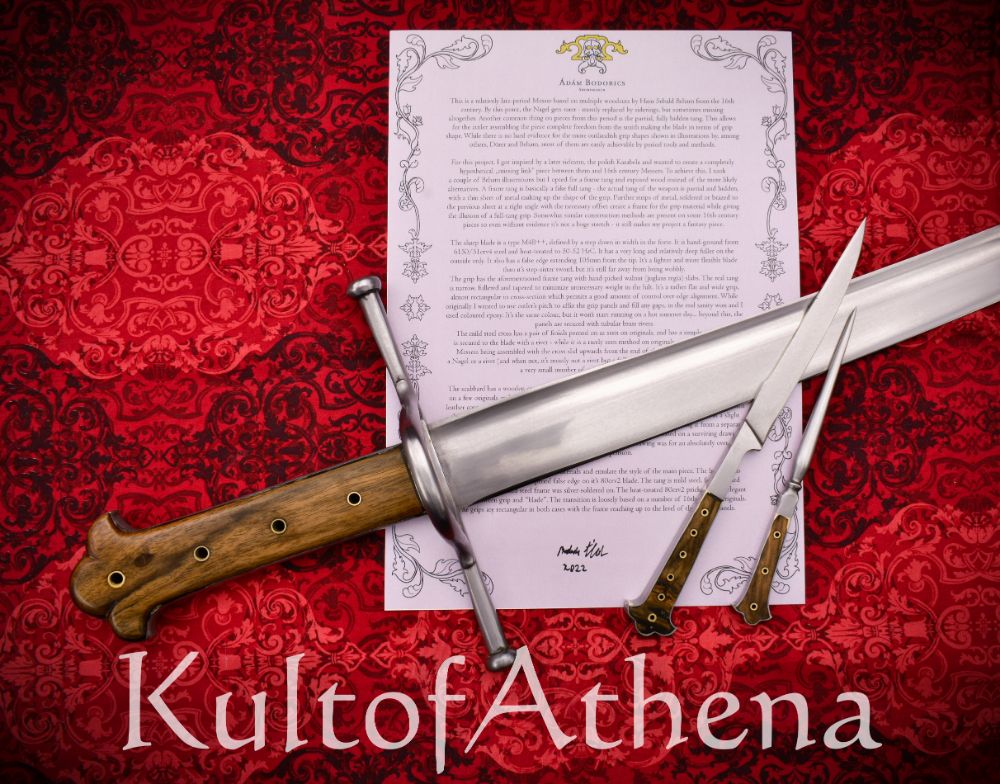
Ádám Bodorics – Frame Tang Beham Messer
Out of stock
$1,648.00
- Shipping estimated at checkout
- Every blade inspected before shipping
- 30-day returns
- Class
- Battle Ready
- Overall Length
- 35 9/16"
- Weight
- 2 lbs 1 oz
- Brand
- Ádám Bodorics
- Culture
- German
- Era
- Medieval
Overview
Ádám Bodorics - Frame Tang Beham Messer
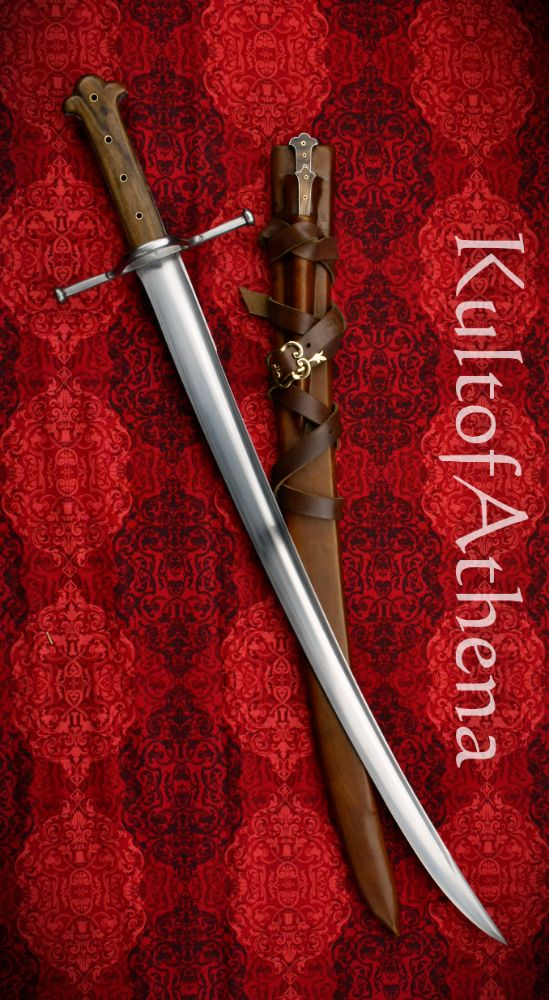
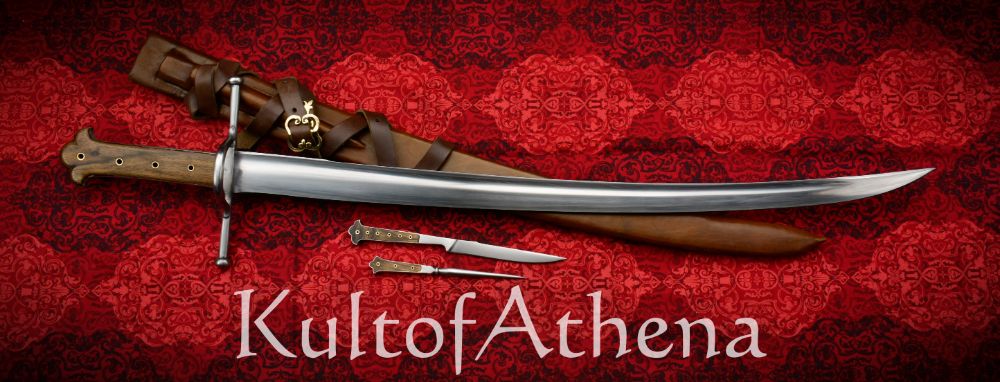
This late-period Messer ably strides the balance between the Messer and an early saber and in the hand it feels exceptionally responsive and capable of powerful cutting strokes and slashes. A close look shows the tell-tale signs of artisanal craftsmanship for this custom piece which gives it some great period character. A wood-core scabbard by András Mezősi complete with equally well-crafted byknives further dignifies this unique sword. Included is a signed Certificate from bladesmith and artisan Ádám Bodorics which details his thought process when creating this piece. Read on to see his thoughts for this sword in his own words and his unique take on how to achieve a fine balance for the sword with its hilt construction:
"This is a relatively late-period Messer based on multiple woodcuts by Hans Sebald Beham from the 16th century. By this point, the Nagel gets rarer - mostly replaced by siderings, but sometimes missing altogether. Another common thing on pieces from this period is the partial, fully hidden tang. This allows for the cutler assembling the piece complete freedom from the smith making the blade in terms of grip shape. While there is no hard evidence for the more outlandish grip shapes shown in illustrations by, among others, Dürer and Beham, most of them are easily achievable by period tools and methods.
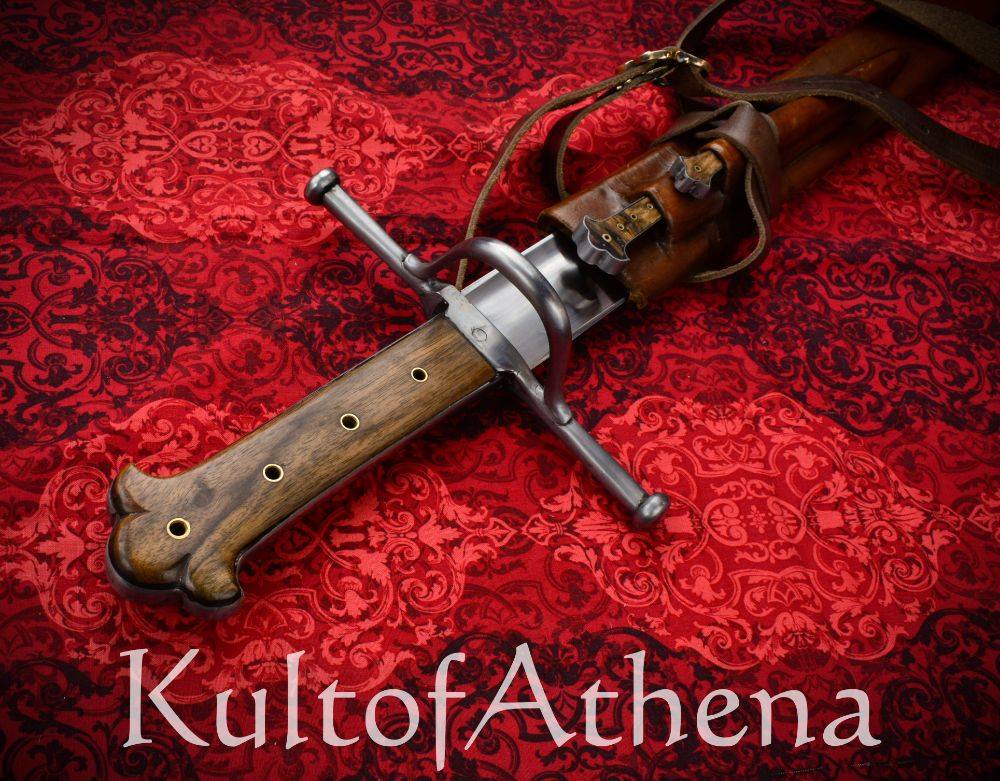
For this project, I got inspired by a later sidearm, the polish Karabela and wanted to create a completelyhypothetical "missing link" piece between them and 16th century Messers. To achieve this, I took a couple of Beham illustrations but I opted for a frame tang and exposed wood instead of the more likely alternatives. A frame tang is basically a fake full tang - the actual tang of the weapon is partial and hidden, with a thin sheet of metal making up the shape of the grip. Further strips of metal, soldered or brazed to the previous sheet at a right angle with the necessary offset create a frame for the grip material while giving the
illusion of a full-tang grip. Somewhat similar construction methods are present on some 16th century pieces so even without evidence it's not a huge stretch - it still makes my project a fantasy piece.
The sharp blade is a type M4B++, defined by a step down in width in the forte. It is hand-ground from 6150/51crv4 steel and heat-treated to 50-52 HrC. It has a very long and relatively deep fuller on the outside only. It also has a false edge extending 105mm from the tip. It's a lighter and more flexible blade than it's step-sister sword, but it's still far away from being wobbly. The grip has the aforementioned frame tang with hand-picked walnut (juglans regia) slabs. The real tang is narrow, fullered and tapered to minimize unnecessary weight in the hilt. It's a rather flat and wide grip, almost rectangular in cross-section which permits a good amount of control over edge alignment. While originally I wanted to use cutler's pitch to affix the grip panels and fill any gaps, in the end sanity won and I used coloured epoxy. It's the same colour, but it won't start running on a hot summer day... beyond this, the panels are secured with tubular brass rivets.
The mild steel cross has a pair of finials peened on as seen on originals, and has a simple sidering. It is secured to the blade with a rivet - while it is a rarely seen method on originals, with most sideringed Messers being assembled with the cross slid upwards from the end of the tang negating the need for a Nagel or a rivet (and when not, it's mostly not a rivet but a full-blown Nagel inside the sidering), there is a
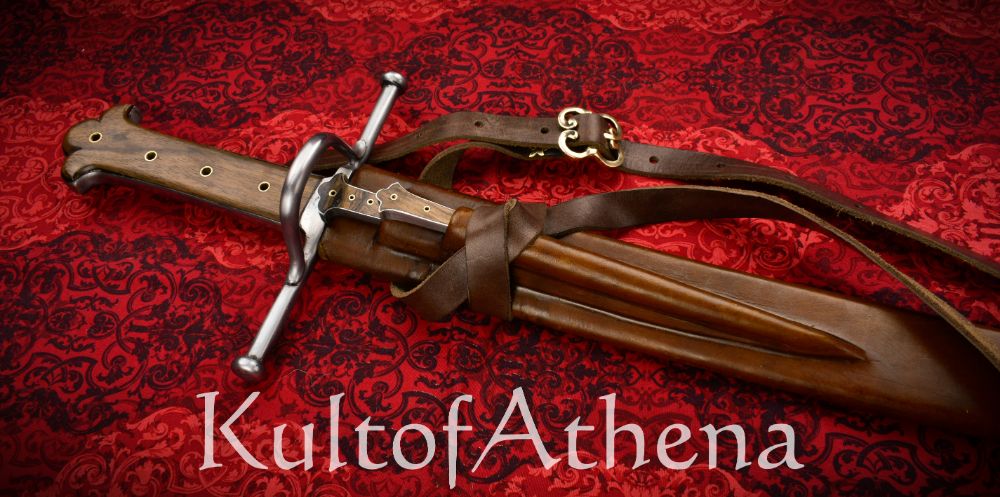
very small number of originals showing my method. The scabbard has a wooden core, wrapped in linen and covered in leather. It has a type of suspension seen on a few originals and strongly implied by several illustrations. There is a pair of vertical slits cut into the leather cover with the area between the cuts raised, forming a channel for a belt. The belt goes through with the flesh side facing the scabbard and loops around from either side. It suspends the scabbard at a slight angle from vertical. While it’s quite flexible and mobile, it’s more stable than suspending it from a separate belt by a loop formed of cord. The belt has a buckle fabricated from brass, based on a surviving drawing from 1555 by Pierre Woeiriot. It’s simplified a bit as the original drawing was for an absolutely
over-the-top mannerist suspension.
The hand-forged bypieces match the materials and emulate the style of the main piece. The byknife has a stepped back and an unsharpened false edge on it’s 80crv2 blade. The tang is mild steel, forge-welded into
the bolster. The mild steel frame was silver-soldered on. The heat-treated 80crv2 pricker has an elegant transition between grip and “blade”. The transition is loosely based on a number of 16th century originals. The grips are rectangular in both cases with the frame reaching up to the level of the walnut panels." - Ádám Bodorics
Specifications
Every measurement that matters
- Brand
- Ádám Bodorics
- Culture
- German
- Era
- Medieval
- Pommel
- Integrated
- Overall Length
- 35 9/16"
- Blade Length
- 28 3/8"
- Weight
- 2 lbs 1 oz
- Edge
- Sharp
- P.O.B.
- 5 18"
- Thickness
- 5.7 mm - 3 mm
- Width
- 43 mm
- Grip Length
- 5 1/4"
- Class
- Battle Ready
- Country of Origin
- Hungary
Reviews
What collectors are saying
Q&A
Questions from the community
No questions yet — be the first to ask.
The Maker
Ádám Bodorics
Ádám Bodorics is a artisan from Landsknecht Emporium who also creates his own separate swords, daggers and other pieces. He takes great care not only in the craftsmanship of the pieces, but strives to give them a great balance and practical useability. He does a great deal of research for many of his pieces and his scholarly take when combined with his handworked craftsmanship creates pieces of unique character. Many of these pieces from him also come with scabbards or sheaths which are often crafted by fellow Landsknecht Emporium craftsman András Mezősi . As artisanal pieces quantity is limited, but when we have some you can find them here. Below you can read more about bladesmith Adam Bodorics in his own words:
“I started trying to make bladed tools and weapons when I was about 11, and just didn’t stop. Beyond grinding most of Landsknecht Emporium’s blades during regular work hours, I started making more and more custom and unique pieces in my free time. Right now my personal business serves as an outlet for these projects and for the occasional custom order the main company couldn’t fit into a sane schedule. I’m mainly focused on Messers and related pieces, slowly working my way up to tackling a Sumersperger-inspired piece or a dozen. One of my main aspirations is to get good enough to be able to create pieces in the Mannerist style.” – Ádám Bodorics
Often paired together

No reviews yet. Only logged in customers who have purchased this product may leave a review.