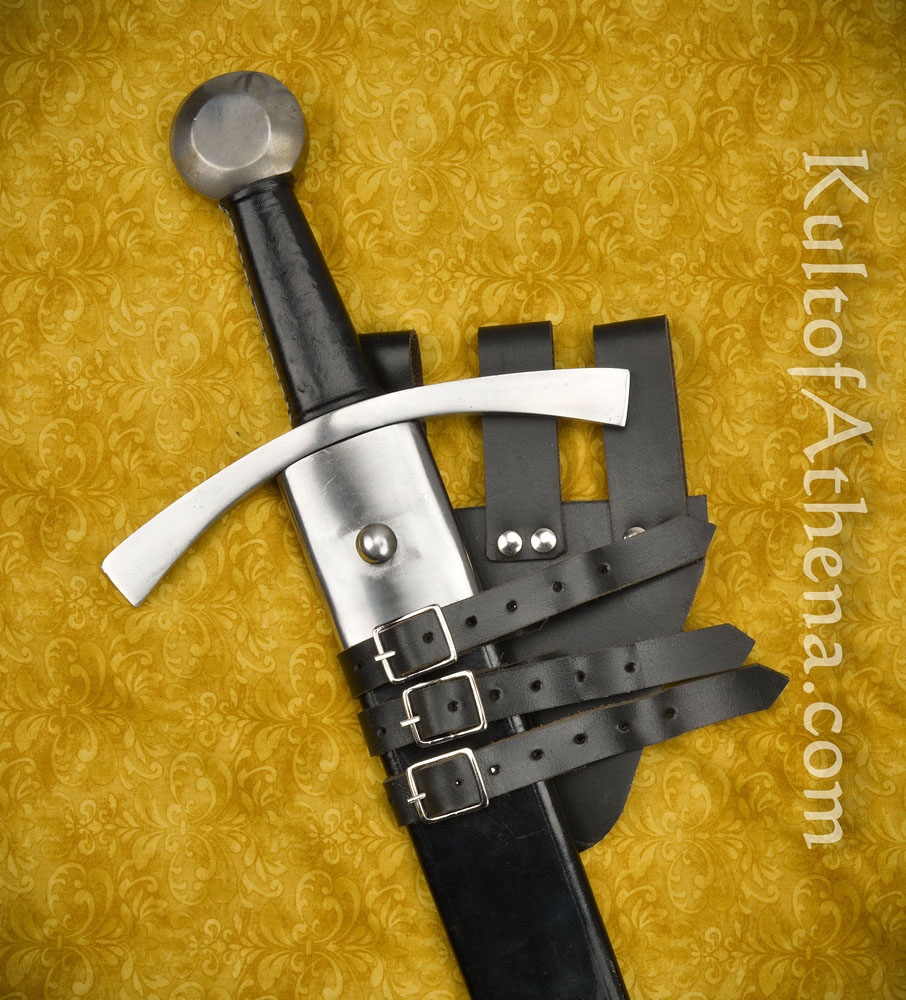
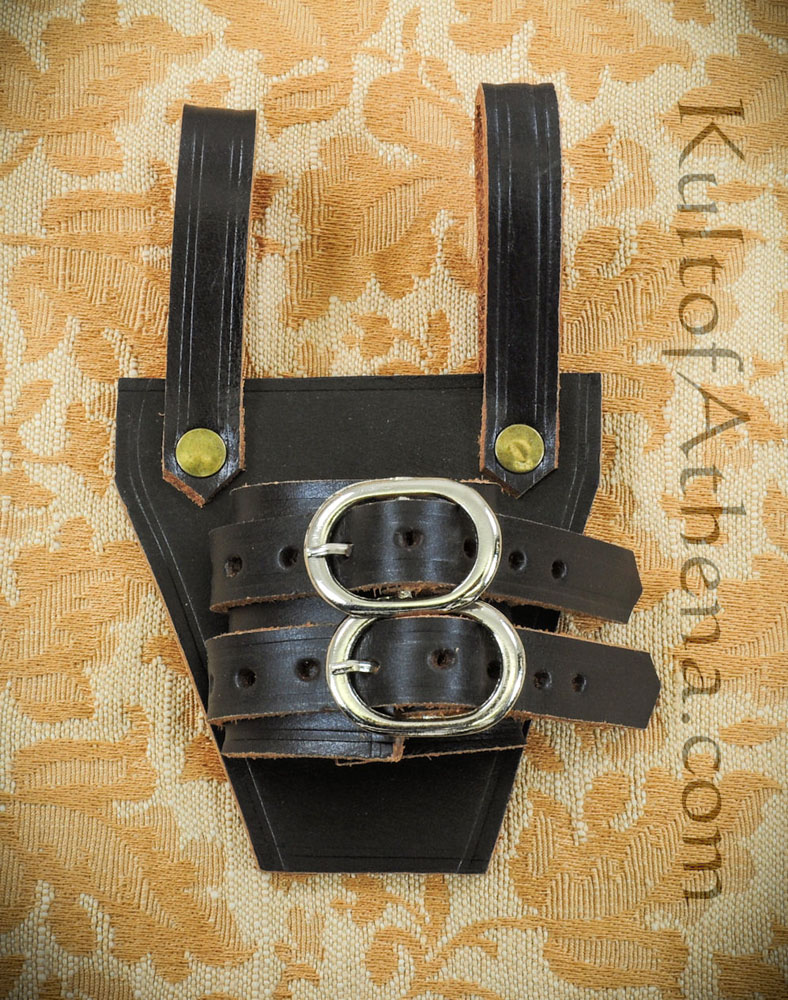
This Sword Frog is constructed from riveted thick leather that is 8-9 oz in thickness; a set of adjustable straps and brass buckles allow it to grip and hang your sword scabbard. Integrated belt loops allow it to be simply worn from a belt.
Please Note: You may need to add extra holes on the straps to tailor the fitting of the frog to your own scabbard for an optimal fit. With this sort of modification it can be made to fit most rapier scabbards.
Circumference of Scabbard Straps can be adjusted from 3 1/2” to 4 1/2” – Fits belts up to 3” Wide
This brown leather sword frog has two steel buckles with adjustable straps. It is held together with brass rivets and has two integrated belt loops. It will fit scabbards for most swords, though it cannot be drawn tight enough to hold the scabbards of thin rapiers, smallswords and thin sabers. The scabbard should be at least approximately 2 wide at its throat to snugly fit in this frog. The buckles allow the frog to hold a scabbard with a maximum width of approximately 3 1/8.
Please Note: The hue and color of the leather can vary from light brown to very dark brown
Please Note: Sword and scabbard are for demonstration purposes only and are not included
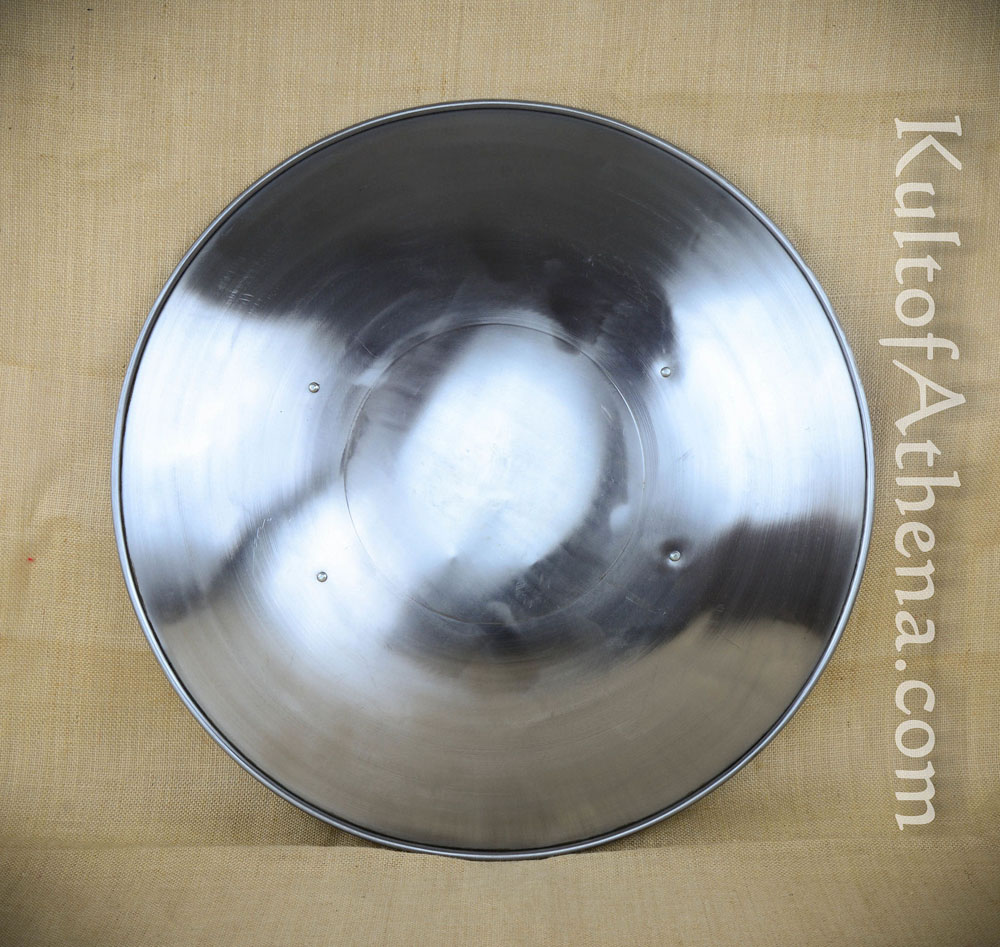
This steel round shield is crafted from 20 gauge steel with a rolled edge for increased durability and impact resistance. The reverse is blackened and fitted with an thick, wide and durable leather forearm strap that can be adjusted to size with its large steel buckle. A stoutly riveted grip of wood with a steel frame serves as a palm grip. A riveted and stuffed canvas panel acts as a shock absorber to give the forearm some impact padding.
Popular with infantry in both Italy and Spain throughout the Medieval Period, round shields took on a new role in the Renaissance as the swordsmans shield of choice. Commonly paired with a rapier for dueling, or a cut-and-thrust sword for the battlefield, the steel Rotella / Rodelero shield was ideal for an aggressive fighter who would use the shield to deflect blows and deny angles of attack when rapidly advancing on a foe; In close quarters the shield doubled as another weapon of opportunity for a skilled swordsman. This is a shield that was designed not to sit as a static defense barrier, but to be quick, light and simultaneously capable of defending the swordsman whilst harassing or even attacking the foe.
Late Medieval and Renaissance battlefield tactics were often formed around solid blocks of halberdiers and pikemen and opposing formations of polearms could often entangle and deadlock. Thus specialized sword-and-buckler men armed with medium-sized steel round shields and cut-and-thrust swords were often deployed in fast striking groups to aggressively engage and disrupt these longer-range polearm formations.
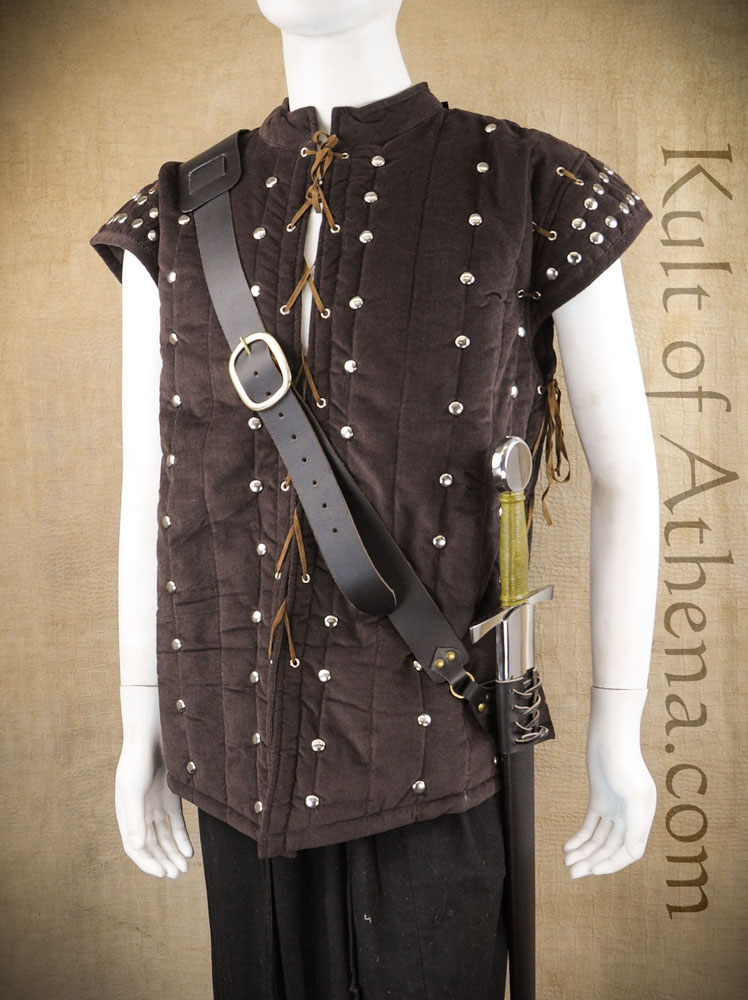
This black leather baldric is intended to be worn by a right-handed user. It is made from blackened leather, brass hanging rings, brass rivets and an adjustable steel buckle. The baldric has been fitted with an enlarged leather pad to distribute the weight of the weapon on the shoulder better.
It can hold the scabbard of a weapon in its laced leather frog hung from the baldric by two brass rings. The frog can fit narrow scabbards and can be enlarged to fit medium scabbards by extending the lacing The frog can not be made narrow enough to to grip a rapier scabbard.
The lacing provided is not long enough to make a solid lacing for a medium width scabbard, such as demonstrated in the photo – it ideally would require longer lacing. The lacing can be easily removed and replaced with one of your own if desired.
The lacing can be made to fit the haft of an axe or mace as well.
Please Note: Gambeson, Sword and Scabbard are for demonstration purposes only and are not included.
Many associate the Renaissance as being a period in which swords became lighter and rapier-like and that it is evidence of skill and swordplay evolving from brutish hacking of earlier centuries. This is barely half-true. In the Renaissance civilian swords did become thinner and focused on thrusting, but the 16th Century Renaissance battlefield was an entirely different affair. The battlefields of the Italian city states and German principalities could be characterized as a mass shoving affair between tightly packed formations of men-at-arms with pikes and halberds – it was a rebirth of the Grecian Phalanx.
Unlike civilian swords which became better suited for close-quarters duels, the martial swords of the Renaissance were largely a further development of more familiar medieval forms into blades intended to defeat armor and fight around and within mass infantry formations. There are too many specialties to go into detail with here, but among the most fascinating development was among the two-handed swords.
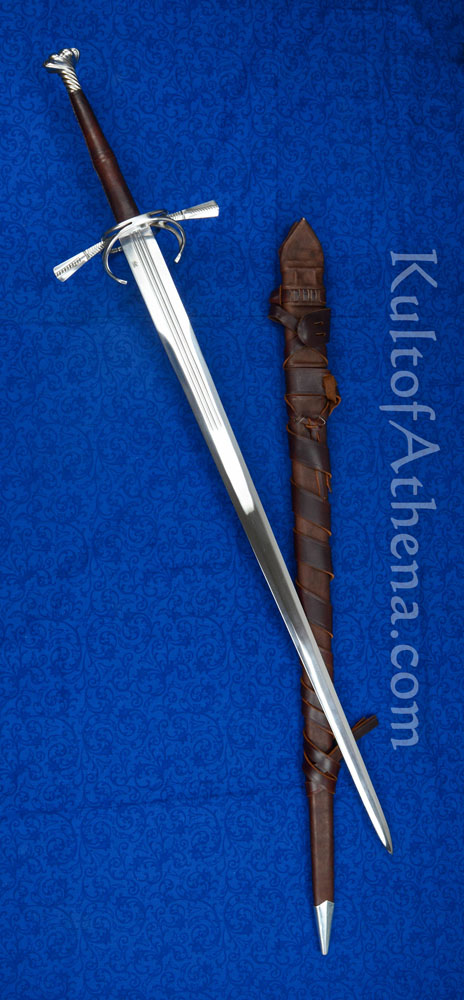
They varied in size from up-scale ring-hilt bastard swords (like the example offered here by Darksword) to massive wave-bladed weapons as tall as the man wielding it. They appear wholly unwieldy, but in skilled hands they were more agile and utilitarian than they appear. Massively powerful sweeping cuts can be made, and much of the additional protective rings and blunted, thick ricasso above the guard is made to facilitate a choked up grip. In closer quarters the skilled wielder would use the blade in sweeps to deflect weapons and could stab, chop and even pound at the foe with the guard quillons and pommel at point-blank range with the choked-up grip. The extensive guard is designed to not only protect the hand, but to even momentarily entrap an enemy weapon, leaving him open for the strike. Though brutishly powerful, there were schools of technique for the use of the two-handed sword and a skilled user could be surprisingly dextrous in the use of these grand swords.
These two handed swords had a special place in large-scale battles; they were used to disrupt the formations of pikemen. Moving ahead of their own formation, they would strike at the pikes, knocking the long unwieldy weapons aside and even in some instances breaking off the pike tips to create gaps for their own pikemen to exploit. Among the famed German mercenary landesknechts, these two-handed swordsmen were called Doppelsdner. Literally meaning Double-Soldier these men were paid double what their pike-brethren were paid for undertaking the dangerous job of challenging a hedgehog wall of pikes with his sword.
This 16th Century Two-Handed Sword from Darksword Armory is based on an original found in the River Thames, London and dates to 1500-1525. It has an unsharpened blade of high carbon steel. The guard and pommel are of steel and the grip is tightly wrapped in brown leather. It comes with a wood-core scabbard that has an integrated brown sword belt.
This main gauche can be stylistically paired with the Musketeer Rapier to create a matched sword and dagger set. Available separately (SKU 500784)
Carried at the back for a left hand draw, the main gauche was often brought into play with the rapier for a two handed fighting style. The Musketeer Main Gauche features an unsharpened high carbon steel blade with cut-outs and notches to slow or disrupt an opponent’s blade. The guard is polished steel with an etched cross design, while the grip it wood with a wire wrap. Includes a matching leather scabbard with steel accents.
The Colichemarde emerged on the sword scene in the late 1600’s during the decline of the Rapier and the rise of the small sword. Its long suit was its uniquely shaped blade that was extra wide at the forte then stepped down or narrowed for the rest of its length before ending in a wicked point. The advantage of this configuration was it allowed the sword to be used to parry or oppose even the heaviest weapons without breaking, yet remain light and supple enough to take full advantage of its lightning quick point.
Cold Steel president Lynn C. Thompson has long been an admirer of the Colichemarde due to its great versatility in attack or defense so with the aid of designer Dave Baker, Cold Steel offers this modern interpretation. True to form, the 1055 carbon steel blade mirrors the original design concepts with an extra long and wide forte that abruptly tapers down to an acute and deadly point. The hilt features a decorative, yet highly functional, double shell guard, complete with finger loops and knuckle bow, while the grip is completely wire wrapped and capped with a matching pommel.
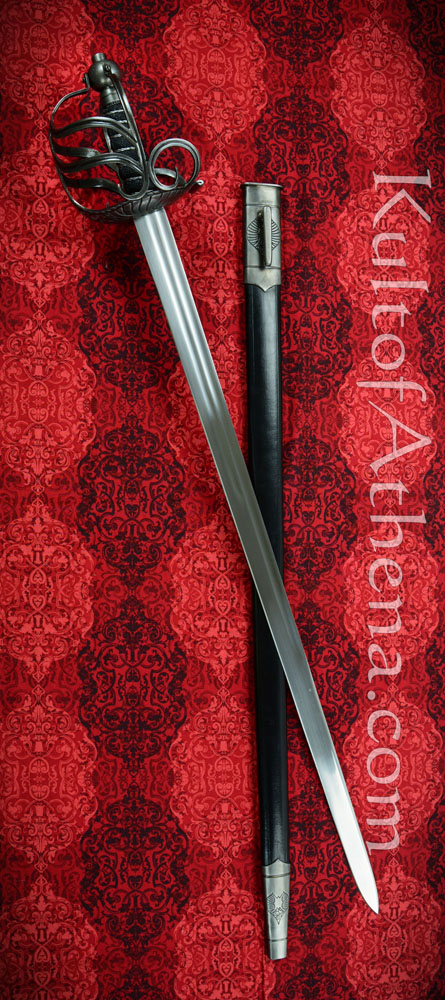
This English Backsword is fitted with a blade of sharpened 1055 high carbon steel. The steel hilt has been treated with a darkened, antiqued finish. The grip is faux rayskin inlaid with twisted steel wire. The scabbard is of leather and finished with an antiqued steel chape and locket.
What a brave weapon is short sharp light sword, to carry, to draw, to be nimble withal, to strike, to cut, to thrust both strong and quick. – George Silver, from his Paradoxes of Defense – 1599
The Elizabethan George Silver was a major proponent of the English backsword in lieu of the rapier. Though he was quite familiar and able with the rapier, he preferred the cut-and-thrust versatility of the backsword over the thrust-oriented rapier and he extolled it as a weapon suitable for street self-defense and the battlefield over the rapier which was optimized for the duel, but unsuitable for the battlefield. He even called it a dangerous weapon because it could not offer enough protection to its user.
Silver believed that the swordsman should be paired with a weapon and a fighting system suitable for all situations, instead of focusing ones efforts into gentlemanly duels at the expense of other, more practical martial applications.
Silver extolled the virtues of native English swordsmanship over the fashionable swordsmanship of the rapier duellists from Italy who taught duelling in England at the time. He prove their methods impractical and inferior he once challenged Italian fencing master Vincentio Saviolo to a duel with a variety of weapons in a public event. Though Silver and his students drummed up much publicity for the event, Saviolo himself did not appear.
Cold Steels English Backsword has a well-tapered blade well-suited for both cutting and thrusting. It can hack decisively whilst maintaining a notable degree of practical agility. The mortuary-style hilt provides excellent protection for the hand and the tempered blade is thick and flexible enough to capably parry even the harder-hitting swords of the Elizabethan battlefield whilst keeping the thrusting agility needed to ensure it is a capable dueling and self-defense blade.
Order Status
You will receive an email notification, including tracking information, when the order ships. If you ordered an in-stock item, please reach out to us only if you have NOT received a shipment notification after 7 business days.
We prioritize quality over speed.
Our shipment times include an amount of time for us to inspect and then appropriately package and protect your purchase before we ship. We are proud to be famous for our brown-paper protective wraps which help your purchase arrive in excellent condition.
Shipment times will vary due to the stock status of an item and whether you included other services, such as sharpening, in your order.
If an item is in-stock, we aim to ship within 7 business days of your order. If you have added sharpening, it may add up to an additional 7-10 business days.
Our items that are listed as Usually Ships in One to Two Weeks normally ship within 10-14 days.
Thank you for being a valued customer!
Kult of Athena Team
Local Pickup
After you place your order, we’ll work on getting it ready as soon as we can. We know you’re excited to get your new items, but please make sure you wait to hear from us before you head over to our facility for pickup. We don’t want you to show up before your order is ready and have to wait.
You’ll receive a call or an email from us as soon as your order is ready for pickup.
See you soon!
Kult of Athena Team
Deposits
Take advantage of our deposit option and pay only a deposit (+shipping) at this time. The cart will process this as a normal order and calculate your shipping costs so you know what to expect. When the item is available to ship we will contact you for the balance.
Please note: this deposit is non-refundable. Turn around time is an estimate and can vary depending on the manufacturer’s given work load.
This option is not for in stock items, it is only for special orders with long turnaround times. If you do order something marked as in stock, the stocked model will not be held for you. A new special order with the listed turnaround time will be started for you instead, to allow you the time to pay off the full price.
Unsharpened
Unsharpened edges will be thinner than a “blunt” edge, but will not offer any cutting ability. They will typically taper towards an edge, but then stop short.
Sharpening Service
Overview
Our sharpening service will provide a good serviceable edge on the blade. The result is typically “very sharp” with a small secondary bevel and a bit of an “apple seed” profile. The resulting edge is somewhat dependent on the particular blade. Some blades will take and hold sharper edges than others and the thickness of the blade will determine how wide the bevel will need to be. We adjust the angle of the edge to suit the specific blade and attempt to get as close to a bevel-less edge as possible without marring the surface of the blade.
The Sharpening Process
The sharpening service is done with a belt sander. The process involves many passes with sanding belts of various grits. The blades are rested between passes to prevent them from becoming hot and damaging their temper. By default we will sharpen as much of the blade as possible including any false edges if appropriate. If you have a different preference, feel free to make that request in the special instructions at check out. We can sharpen only the last half or third of an edge, for example. Our sword sharpening expert has personally sharpened several thousand swords at this point, so will provide you with a professional service.
What the Service is Not
The resulting edge will be “sword sharp” not razor sharp. Our goal is to provide you with a usable edge for cutting practice that will hold up to some use and not require constant re-sharpening. In other words, we intend to provide you with a serviceable weapon, not a personal grooming implement. The service will not provide a completely bevel-less edge. To create that type of edge will necessarily scratch up the blade surface and we lack the machinery and time to provide a full re-polishing of a blade’s surface. A service of that nature would be significantly more expensive as a great deal more time would be required. We do not offer this type of service at this time.
Disclaimer
We make no guarantee that the resulting edge will meet with your expectations. Every blade is different and some will take and hold a sharper edge than others, due to the blade material, heat treatment or geometry. Some customers can also have incorrect assumptions about sword sharpness and improper expectations as a result. All we can say for sure is that the resulting edge will be sharper than the default edge, in most cases, significantly so. We can not provide any refunds for the service once it has been completed, so consider it to be provided “as is”. That being said, if you are unhappy with the product for any reason, we do still allow you to return the item for a full refund, including the sharpening costs under our normal return policy. This does not apply to special sharpening requests, for example if we sharpen something specially for you that does not normally list that option on our site. The vast majority of our customers are happy with the results of the service, so as long as you keep the above mentioned in mind, we are confident you will be pleased with the results as well.
Grade
Blemished
A factory blemished model will have small cosmetic defects but no issues that will affect its function. Examples include, small surface scratches, scabbard dents or cracks, minor blade pitting, etc. Larger issues like blade chips, cracks, warps or anything else that will affect performance will not be included with these. Please note that we do not keep track of every specific minor blemish, so please do not contact us asking for details, we will not have them available. We are offering these items at a further discount for customers who are not overly concerned with cosmetics and intend to put them to some use.
Munitions Grade
A munitions grade item is not up to our normal high standards. Munitions grade items will typically have various bends or twists in the blades, basically rendering them as 2nds quality. These items are still a great choice for collecting and re-enacting and functional pieces will still be functional. Please keep this in mind when ordering.
Munitions Grade
This “Munitions Grade” item is not up to our normal high standards. Munitions grade items will typically have various bends or twists in the blades, basically rendering them as 2nds quality. These items are still a great choice for collecting and re-enacting and functional pieces will still be functional. Please keep this in mind when ordering.
Country of Origin
“Country Of Origin” refers to the coutry where the product was manufactured. This is not to be confused with the “Culture” spec. For example, a culturally “Japanese” Sword could be made in India, a culturally “German” sword could be made in the US or a culturally “Indian” sword could be made in China. The historic “culture” associated with a particular sword and the country a reproduction is currently being made in, are two separate things and should not be confused.
Manufacturer
As you would imagine, the “Manufacturer” spec refers to the brand or company the item is made by. Not all products will have a manufacturer listed. Some products do not fall under a specific brand.
Culture
The “Culture” spec will denote if the item is associated with a specific group of people, conflict or geographic area. For example, “Viking”, “Crusader”, “Pirate”, “Indian” “WWII”, and so on. Please note that many items will not fall into a specific culture like this and were used by many peoples or across many time periods.
Class
The “Class” spec can have four possible values:
Battle Ready – For functional weapons
Sport Combat – (also known as Stage Combat) For blunted fighting weapons
Decorative – For display only weapons
LARP – For Foam fighting weapons
P.O.B.
P.O.B. stands for Point Of Balance, this is measured in inches from the hilt down the blade. It refers to the point on the blade where the sword achieves a perfect balance. A number of 0” would balance exactly at the guard, while a negative number will have a POB in the hilt itself. In theory a sword with a POB of 0” is perfectly balanced. In practice however, there are many reasons why you may not want this for a particular sword. A POB of 3”- 5” usually results in a well balanced sword, but does depend on the type of sword. In general, a low POB results in good point control well suited to a thrusting blade, while a higher POB adds impact to a cleaving blade. A very high POB will result in a sword that feels heavier than it actually is and is difficult to wield.
Please note: Due to the hand made nature of these items, all specs should be considered as approximates. This info is provided to give you a good idea of the product being presented, the one you receive may vary from the specific one we took measurements of.
Pommel
The Pommel entry refers to how the pommel, and usually by extension the whole sword, is held together. Possible values include “Peened” where the blade tang goes through the pommel and is hammered flat at the end, Threaded” where the end of the tang has threads and the pommel is screwed on, or “Nut” where the tang goes through the pommel and is secured by a separate threaded nut at the end.
Thickness
“Thickness”, not to be confused with a blade’s “Width” is measured in millimeters on the blade where it first leaves the hilt and will refer to the thickest portion. For example the back edge on a katana or the mid section on a diamond shaped blade. Sometimes you will see two entries here, in that case it is usually because the blade is “distal tapered” meaning that it gets thinner towards the tip. The second measurement is taken approx. 1” from the tip.
Please note: Due to the hand made nature of these items, all specs should be considered as approximates. This info is provided to give you a good idea of the product being presented, the one you receive may vary from the specific one we took measurements of.
Width
On blades, the “Width” is measured in millimeters and is taken where the blade leaves the hilt. A second measurement is provided when a blade widens further down, such as in a leaf shaped blade. The second measurement is taken at the blade’s widest point.
Please note: Due to the hand made nature of these items, all specs should be considered as approximates. This info is provided to give you a good idea of the product being presented, the one you receive may vary from the specific one we took measurements of.
Edge
The “Edge” spec will tell you about how sharp a blade is. Possible values could be “Rebated” meaning the edge is intentionally thickened for safety, “Blunt” meaning the edge is fairly thick with little to no taper, ‘Unsharpened” which would taper to the edge but stop short of having any real cutting ability, “Slightly Sharp, Moderately Sharp , Sharp, or Very Sharp” Sharp or Very Sharp are considered good for cutting swords. Moderately Sharp is close, but may need to be touched up to get the best performance. A common misconception is that swords should all be “razor sharp”. However for reasons we won’t get into here, this is not the case.
Please note: Due to the hand made nature of these items, all specs should be considered as approximates. This info is provided to give you a good idea of the product being presented, the one you receive may vary from the specific one we took measurements of. The Edge ratings in particular are somewhat subjective and each blade can vary. Consider this as a general guideline only.
Weight
The “Weight” spec refers to the item itself and does not include any packaging or accessories. For example, it would be the weight of a sword not including a scabbard.
Please note: Due to the hand made nature of these items, all specs should be considered as approximates. This info is provided to give you a good idea of the product being presented, the one you receive may vary from the specific one we took measurements of.
Overall Length
As you’d imagine, “Overall Length” is the full length of the item in question. It is the length of the main item itself, not including any accessories. For example, this measurement for a sword would be for the sword itself, from the tip of the blade to the end of the pommel. This measurement will not include any scabbards, sheaths, boxes etc.
Please note: Due to the hand made nature of these items, all specs should be considered as approximates. This info is provided to give you a good idea of the product being presented, the one you receive may vary from the specific one we took measurements of.
What is "Battle Ready?"
Swords marked as “Battle Ready” are made to a higher standard than your average display weapons. The blades are usually made of carbon steel, as opposed to the more brittle stainless steel and feature longer and stronger tangs.
“Battle Ready” does not necessarily mean the blade is sharpened, this depends on the manufacturer. Some sell them sharp like Cold Steel, some dull like Windlass Steel Crafts, and some do both like Hanwei. So if you need to know if it is sharp or not and it is not mentioned in the description, just ask.
In general “Battle Ready” swords are functional weapons that will live up to actual combat usage. They are closest to historic examples in the fact that when properly sharpened they can cut as designed. However, “Battle Ready” does not mean indestructible. Any sword can be broken. Use common sense with your sword, and it will last for generations. A sword being listed as “Battle Ready” does not constitute a guarantee that it will withstand any abuse you can throw at it. “Battle Ready” swords are not designed for blade to blade type combat, you will want to select “Stage Combat” swords for this activity.
What is "Sport Combat?"
Swords listed as “Sport Combat” (also known as “Stage Combat”) are specifically designed for combat reenactment, stage and film fights, and other activities where they will be hit edge to edge together.
Using a sword in this capacity is very different than how a sword would have been used historically, and as a result the sword must be made differently. Sport combat swords feature extra strong tangs and thick blades with thick edges. Sport combat swords will generally weigh more than a “Battle Ready” equivalent and are not made to be sharpened.
Swords listed as “Sport Combat” will hold up to a fair amount of usage, but will wear out with time. No sword is indestructible, and “Sport Combat” swords are no exception.
Blade Length
On a sword, knife or dagger, The “Blade Length” spec is measured from the tip of the blade to where the blade enters the hilt, this will include a ricasso portion if present. For katanas, this measurement includes the habaki.
On a spear it is a measurement of the edged portion and does not include the socket. On an axe, it is a measurement of the axe edge itself, in a straight line from point to point.
Please note: Due to the hand made nature of these items, all specs should be considered as approximates. This info is provided to give you a good idea of the product being presented, the one you receive may vary from the specific one we took measurements of.