The largest collection of swords, weapons & more from the Bronze Age to World War II

Ádám Bodorics – All Steel Bauernwehr and Scabbard

This stylistically unique and custom crafted Bauerwehr bt Ádám Bodorics has a sharpened and well tempered blade which is solidly constructed and matched to a hilt of steel. The dagger comes with a scabbard of wood hich is sheathed in steel and completed with a steel hanging belt loop. The dagger feels quite capable and authoritative in the hand and its blade has a thick spine to ensure it has excellent durability. A certificate of authenticity is included and signed by Ádám. Below are Ádám’s own thoughts on his custom creation:

The Bauernwehr is the dagger-sized relative of the Messer, and it also exhibits noticeable variation. This specific piece has no historical analogue as far as I know, rather it’s an interpretation of a trend present on a variety of different sidearms from the period. All-metal and full-steel sidearms appear with some regularity from the end of the 15th century.

We see it on an early rapier, a glorious Kriegsmesser, several quillon daggers, stortas – so to me it made sense to create a Bauernwehr in this style. The blade is hand-forged and ground from 80crv2 and is heat-treated to 54-56 HrC. It has a minimal amount of distal taper to avoid making it too hilt-heavy. The false edge is also fully sharpened. There is a narrow and shallow fuller on both sides along the spine. The tang extends into the hilt only partially and is heavily tapered. The entire hilt is forged, ground, filed and chiseled from a single piece of mild steel. The “bolster” and “pommel” areas are marked out with pairs of filed lines, further decorated with chiseled lines. The fuller extends from the “bolsters” all the way through the “pommel”, with the sides further emphasized with a filed border. The “grip” area is lightly decorated with chiseled diagonals, emulating the puff&slash fashion slowly coming into vogue by the end of the century. It is secured to the blade by five steel rivets peened and filed down. Three rivets are along the tang, one at the edge end of the “bolsters” and one at the spine end of them.

The Nagel is also embellished by filework and chiseling, and is peened on the other side, with the peen filed down very close to the fuller of the grip. The entire hilt was cold-blued with a light touch bringing out the high spots, highlighting the details. The scabbard is based on a variety of dagger scabbards, redesigned to fit the curved blade. It has a wooden core and a mild steel cover fabricated from multiple pieces. It emulates the puff and slash fashion of the 16thcentury and has a relatively simple and subdued finial. The suspension is a chain made up of strips and rings of steel, based on a period original, terminating in a steel belt loop. It is also cold-blued and highlighted to match the hilt.

Cold Steel Small Sword

The advantage of the sword point over the edge became increasingly evident by the end of the 16th century. The Rapier, with its long, elegantly thin profile which emphasized its point, became the popular choice in civilian self-defense. It was however a somewhat unwieldy weapon especially when it was used in narrow, crowded streets and alleyways. Eventually a more sophisticated, shorter and lighter version emerged that by the end of the 17th century had evolved into an entirely new weapon, the Small Sword.
Civilians carried it for as long as swords remained an integral part of fashionable dress. Its primary advantage was its stiff, lightweight blade which was forged in a triangular cross section. It was a highly lethal weapon, ideal for thrusting, and hung conveniently from a sash, baldric, or belt. The hilt (compared to the Rapiers) was simple and smartly functional, consisting of no more than an elliptical plate, or two shells and a light knuckle guard.

The Cold Steel Small Sword duplicates the original model in weight, balance, triangular cross section, and deadly sharp point, but uses modern materials like 1050 high carbon blade steel, heat treated to a tough spring temper. The hilt features two shells with functional finger loops and a light, but strong, knuckle guard. Perfectly balanced and weighing only 22 ounces, the Small Sword comes complete with an attractive leather scabbard that features an intricately decorated throat and chape.

In the Service of Mars – Vol I – Proceedings from the Western Martial Arts Workshop 1999–2009

7” x 10” Paperback 340 Pages

In the Service of Mars – Proceedings from the Western Martial Arts Workshop 19992009, Volume I

Martial Arts are literally ”The Arts of Mars,” the Roman god of war. For over two and a half millennia, the combat arts of Europe served the hoplite, gladiator, legionnaire, knight, duelist, boxer and wrestler on the battlefield, in the duel, as street defense and in the ring. Interest in these traditions has grown dramatically over the last twenty years, bringing together a unique combination of fighters and scholars in the quest to resurrect and preserve this proud heritage of fighting lore.

The Western Martial Arts Workshop (WMAW) was founded in 1999 as a way for the students of these martial arts to meet, train, exchange research, and lay the foundation for an enduring Western martial arts community. In the Service of Mars, Volume One is both a compilation of some of the most popular and detailed lectures and class notes from WMAWs first decade, and a record of the growth of the Western martial arts community in depth and breadth over the same time. But it is not only a ”best-of” anthology; most of the inclusions here are substantially different from the form in which they first appeared in the WMAW event guides. The contributions in this book have been substantially revised, expanded, and photo-illustrated, coming as close to recreating an actual class in the subject as the written word can ever replicate a physical discipline.

From armoured axe combat to the elegant and swift rapier; the wrestling of Germany to the swordplay of the Scots Highlander, In the Service of Mars contains something new for every student of the Western martial arts, providing hours of training, food for thought, and a chronicle of the community’s growth over the last decade

Contents:

  • Foreword
  • Part One: Martial Arts of the Middle Ages, ca. 13001550
  • The Dagger Plays of Gladiatoria – Jörg Bellinghausen
  • Bolognese Poleaxe Combat: A New Look at an Old Weapon – Gregory Mele
  • Hawks, Rabbits, and Tumbling Cats: An Analysis of English Longsword Terminology – Paul Wagner Ott s Ringen – Jessica Finley
  • Understanding Wide and Close Play in the Art of Fiore dei Liberi – Gregory Mele
  • Part Two: Martial Arts of the Renaissance and Enlightenment, ca. 15001850
  • George Silvers Four Fights: An Exercise in Reducing Complexity in Combat – Stephen Hand
  • The Fabris Wheel: An Introduction to the Rapier System of Salvator Fabris – Tom Leoni
  • Uniting Your Forces: Power and Efficiency in Italian Rapier – John OMeara
  • Jerónimo Sánchez de Carranza: A Man of Arms and Letters – Mary Dill Curtis
  • The Spadone, Empress of Weapons: An Introduction – Tom Leoni
  • An Introduction to Thomas Pages The Use of the Broad Sword (1746) – Paul Wagner
  • Part Three: Western Martial Arts in Their Historical Context
  • How a Sword Was Made – Craig Johnson
  • The Judicial Duel in Sixteenth-Century Italy – Tom Leoni
  • On the Art of Reading: An Introduction to Using the Medieval German Fightbooks – Keith Alderson
  • Part Four: PedagogyTeaching and the Western Martial Artist
  • Using Classical Italian Pedagogy in Developing Lesson Plans for Historical European Martial Arts – John Sullins, Sean Hayes, Puck Curtis, and Eric Myers
  • Notes on Training: Forms, Intervals and Skill Progression – Guy Windsor

Red Dragon – HEMA Light Sparring Jacket

This Sparring Jacket is made specifically for HEMA and is constructed from 350N rated heavy-duty cotton. This jacket has less padding and weight than the standard Red Dragon HEMA Sparring Jacket and is intended for use with rapier and saber sparring. It provides protection for sparring against these lighter swords without adding the undue weight in the jacket demanded for sparring against heavier weapons. There is no padding on the back because hits to this area are rare; the inner arms are likewise not padded and these are all concessions made to reduce weight and increase breathability.

For HEMA, this product has been classified as either appropriate for all skill levels or appropriate for those with Advanced Skills. Michael Turner, instructor at Tuathair Academy of Swordsmanship, assisted us in categorizing these items for the different skill levels of HEMA participants. These categorizations are meant as guidelines. Please refer to tournament rules for specific competition requirements. For this purpose, we do not include swords that may be used in cutting competitions in the HEMA category.

A thick velcro collar acts as a blade catcher to protect the throat and neck from thrusts that happen to get past the bib of a fencing mask. The front of the jacket has a durable zipper hidden behind a panel and the back of the jacket has an adjustable strap that can be used to taper the waist for a better, streamlined fit to the lower torso. The interior of the jacket is lined for comfort.

Sizing Info: (Please note that all measurements are approximations)

Small – Sleeve Length: 21″(53cm) | Chest: 42″(106cm) | Waist: 38″(98cm) | Length: 24″(61cm) | Weight: 3.5 lbs (1590g)

Medium – Sleeve Length: 22″ (56cm) | Chest: 47″(120cm) | Waist: 44″(112cm) | Length: 25″(63cm) | Weight: 3.9 lbs (1766g)

Large – Sleeve Length: 22″ (56cm) | Chest: 48″(122cm) | Waist: 42″ (106cm) | Length: 23″ (59cm) | Weight: 4.2 lbs (1904g)

X-Large – Sleeve Length: 22″ (56cm) | Chest: 50″(124cm) | Waist: 46″ (116cm) | Length: 26″(67cm) | Weight: 4.6 lbs (2080g)

LK Chen: A Focus on Swordsmanship

“None of the Jians I bought had the handling properties I was looking for.”
LK Chen is one of the most fascinating and dynamic personalities in the sword reproduction world. While only available to the Western market for a short period of time, LK Chen swords are now at the forefront of the wishlists of sword collectors and martial artists.

Ricasso

Some swords have a thickened, block-like section above the guard at the base of the blade to give it more durability / rigidity. This section will not have a sharpened edge. It is more commonly seen on swords like rapiers. It is also a common feature on cheap / low quality swords. 

Quillon(s)

Renaissance term for the crossguard. Used almost exclusively when referring to rapiers.

Kingston Arms Renaissance Side Sword

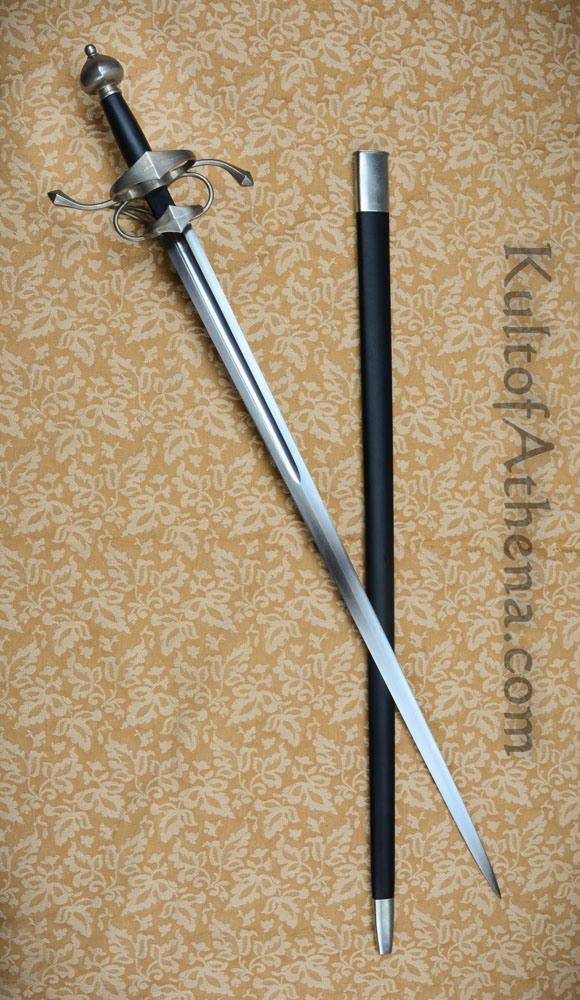
This Renaissance Side Sword has a sharpened blade forged from 5160 high carbon steel. The complex hilt is fashioned from stainless steel with an antiqued appearance. The grip of wood and the blade ricasso are tightly overlaid in supple leather. Included is a fiberglass-core scabbard which is wrapped in quality leather and finished with antiqued stainless steel fittings.

Unlike the rapier, the Side-Sword retains enough meat in the blade width to make it a much more respectable cutter; an acutely tapered tip ensures that it can also thrust with deadly efficiency. Whilst the Rapier was typically a civilian weapon or a weapon of practical self-defense, the Side-Sword, with its greater ability to parry heavier blades could function as a battlefield sword. This example by Kingston Arms is based on a German original and it is quite an agile performer! It is quick on the slash and strike and its balance makes it easy to control the tip in a thrust. The complex guard ably serves to protect the hand and allows the forefinger to safely finger the guard for even greater blade control.

Dragon King – Octopus Carbon Fiber Sword Cane

Intelligent and cunning, the Octopus is a master of disguise and can hide in plain sight; both decisive on the strike and fierce on the defense, the Octopus is quite a fitting inspiration for this sword cane. This tough and eminently functional sword cane has a shaft of glossy carbon fiber with a hard rubber tip for walking support. The Octopus which forms the bold handle-piece of this sword cane is supremely detailed and crafted from antiqued cupronickel and has a solid heft to it.

When sheathed, the rapier-like sword blade is locked into the scabbard with a spring-loaded brass button – a simple press releases the sword for a quick draw. The blade is unsharpened, but the blade edges are quite thin toward to tip to enhance the already capable piercing power of the rigid blade. In capable hands the sword scabbard is no mere walking stick, but doubles as a bludgeon for the off-hand which can both strike with force or deflect a blow.

A cloth sword bag is included with the cane sword.

Please Note: This item can not be shipped to CA or WI – International restrictions may also apply.

Noble Sword – 43” – Foam Sword

This bestselling Epic Armoury Noble Sword is a longsword with a distinctive rapier-inspired hilt. The sword is 110 cm long from point to pommel, with a slim 85 cm double-edged blade. The piece-de-resistance is the cross-guard: a supported bar to catch slashing strikes and a mesh of elegantly circled wire to stop thrusting attacks. The long handle is wrapped in leather and allows one or two-handed use, and is topped by an elegantly carved pommel.

This longsword has the look of a classical renaissance sword and can be used in almost any setting you require, especially if you are looking for refinement or the look of a seasoned veteran.

All latex-coated weapons need a certain degree of maintenance. For this we recommend using maintenance silicone which can be purchased separately. Epic Armoury Maintenance Silicone is an easy, spray-on application, 100% pure and acid-free making it safe to apply. We recommend using Maintenance Silicone on a regular basis. It maintains the latex-coats flexibility and prevents it from drying out, keeping the product wear and tear resistant.

Store your latex weapons flat or on its pommel–NEVER on its tip. Use a simple sheet or towel lining to prevent it from touching a plastic or rubber surface to prevent your weapon from adhering to other products. Keep your weapons in a cool, dry environment.
Please Note: Handpainted Item – Color of weapon, including blade may vary

This weapon is made from foam and is designed for safe sport and roleplay with discretion. It also is quite suitable as a prop for costume and cosplay.

Noble Sword – 41.5” – Foam Sword

Epic Armourys Noble Sword is a long latex-hybrid sword inspired by rapiers of the Renaissance. The sword is 105 cm long and has an 80 cm blade with a central ridge. The crossguard features a looped design to protect the forefinger while providing a precise grip. The grip itself is crafted to appear like real wood, and is 10.4 cm long. This grip, wide by the crossguard and narrow toward the ribbed pommel, is ergonomic in your hand.

Whether you are a noble or a fortunate adventurer, this Noble Sword is one of our highest quality products due to its impressive durability and detail. The blade is made from closed cell foam around a fibreglass core and finished with a strong latex coating, while the handle is a polyurethane foam cast that allows for greater detail and no maintenance. This hybrid model sword will give you confidence in the safety and appeal of your weapon on the battlefield.

All latex-coated weapons need a certain degree of maintenance. For this we recommend using maintenance silicone which can be purchased separately. Epic Armoury Maintenance Silicone is an easy, spray-on application, 100% pure and acid-free making it safe to apply. We recommend using Maintenance Silicone on a regular basis. It maintains the latex-coats flexibility and prevents it from drying out, keeping the product wear and tear resistant.

Store your latex weapons flat or on its pommel–NEVER on its tip. Use a simple sheet or towel lining to prevent it from touching a plastic or rubber surface to prevent your weapon from adhering to other products. Keep your weapons in a cool, dry environment.
Please Note: Handpainted Item – Color of weapon, including blade may vary

This weapon is made from foam and is designed for safe sport and roleplay with discretion. It also is quite suitable as a prop for costume and cosplay.

Albion Museum Collection – The Cluny

The Cluny Sword, a late 15th Century longsword, is one of Albions Museum Line Collection Swords – These are exacting recreations of specific, fine historical swords in the worlds museums. These recreations are founded on Albions sword expert Peter Johnssons hands-on research and analyzation of the originals.

The National Museum of Medieval Art in Paris, also referred to as the Cluny Museum, has an unusually fine late 15th C long sword on display. It was likely created in Southern Germany. The sword is is such good condition that the original grip is still in very good condition. The blade is a slim spike of steel with a diamond section. It is just thin enough for its width to have a useful edge in the mid third of the blade, where cuts tend to be made, while being stiff enough for very effective thrusts. The point is awl shaped and pretty thick, given how nimble it is.The blade is altogether expertly shaped, balancing the need for stiffness, with an economy of material to keep weight down and the edges keen. The bladesmith who forged it had a good eye for shape and a deep understanding of the functional reality of sword blades.

As you grasp this sword you are struck by how very quick and well balanced it is, nimble and light like some rapiers but with space for two hands. It is well balanced, not just in that it is very sweet, light and responsive, but also in that it is so clearly and purposefully suited for a fast type of sword play, that relies on precise thrusts and well aimed and timed cuts. For a weapon of this character, designed for encounters where speed and agility will be a deciding factor, it may perhaps be tempting to classify it as a civilian weapon. While it would surely be very useful in a fight between unarmored opponents, we must not forget that swords of this type are depicted in late 15th C paintings of military saints in full armour. In art of this period we also see young men about town, or on horse back in civilian clothes, with swords such as this strapped to their waist.Being favored for both unarmored and military use, perhaps this kind of very handy long swords are predecessors of the rapier?

The sword shows evidence of having been used in combat, there are some cuts on the blade spine from another sword. The guard has nicks caused by a blade and the grip has a deep gouge where the index finger would normally rest. Hopefully, the wielder was grasping the sword closer to the pommel when his opponents blade found the mid-section of his grip. The Cluny sword stands out not only because it is a splendid example of its type, but also because it is such a beautiful example of the swordsmiths art. Its maker combined supreme functionality with a highly developed sense of form, creating an object that perfectly expresses the spirit of its time.

Albions recreation of this sword has a blade that has been hand ground to shape and tempered for the right mix of flexibility and edge retention and finished to a satin polish. The crossguard and pommel are of blued steel and the grip is wood covered with tight leather over cord. A leather chappe rainguard is fitted over the center of the crossguard.

0
    0
    Your Cart
    Your cart is emptyReturn to Shop