


Turkish Kilij – Universal Swords
In stock
$279.99
- Shipping estimated at checkout
- Every blade inspected before shipping
- 30-day returns
- Blade
- 1060-1065 High Carbon Steel
- Overall Length
- 32 3/4''
- Weight
- 2 lb 6.5 oz
- Brand
- Universal Swords
- Culture
- Turkish
Overview
Turkish Kilij - Universal Swords
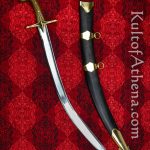
This Turkish Kilij has a blade forged from 1065 high carbon steel and features the traditional Kilij T-section blade spine geometry - a novel design development which both strengthens the blade spine and adds rigidity while minimizing overall weight. This spine cross section transitions into a flared yalman which both increases its cutting power in this wide blade area and will slash deeply with this strongly curved section of the blade. The flattened profile also minimizes blade drag as it passes through a target.
The crossguard and grip accents are brass and the grip itself is well-carved and polished wood. A pre-drilled hole allows for the addition of your own lanyard, sword knot or tassel. The blade tang is stoutly riveted directly with the wood grip halves to create an altogether robust sword construction.
The sword is paired with a handcrafted companion scabbard of wood which is bound in black leather and completed with brass fittings and brass hanging rings.
Please Note: If you wish to have the sword sharpened we will, by default, sharpen the main blade edge and approximately two-thirds of the false edge of the yalman. The false edge will be sharpened in such a way that it will taper and blend into the thicker base of the yalman where it transitions from the thick blade spine. Additionally, the tip will be made more acute and pointed.
The Kilij has its origins in the Turko-Mongol sabers favored by Asiatic steppe and Caucasus cavalrymen. Through contact in both trade and war the Turks spread the Kilij and other curved, saber like blades to other Middle Eastern cultures such as the Persians and Arabs, who themselves previously used straight-bladed swords.
The Kilij becomes a distinctive Turkish saber sub-type around the late 15th century and its design would be refined until the late 18th century with a shorter, stouter blade coupled with a substantially wide yelman tip and strong T-section blade geometry. The reproduction available on this page is of this later, more distinctly evolved representative of the Kilij sword.
The Kilij was well-represented in the Ottoman Empire Turkish Janissary Corps, but its military representation greatly diminished after the Auspicious Incident of 1826 forcefully disbanded the Janissary Corps after the Corps staged an armed and unsuccessful mutiny against the military modernization reforms of Mahmud II. He replaced the Janissaries with a modernized military force and western style sabers were adopted over the traditional Kilij.
Although most strongly associated with the Turks, many Eastern European localities favored the use of Kilij and similar saber-bladed swords due to their contact and proximity with the Turks. It is quite possible that Vlad the Impaler's sword was a Kilij or similar Turkic-inspired saber for his own use.
Specifications
Every measurement that matters
- Brand
- Universal Swords
- Culture
- Turkish
- Edge
- Unsharpened
- Pommel
- Integrated
- Overall Length
- 32 3/4''
- Blade Length
- 26 5/8''
- Blade
- 1060-1065 High Carbon Steel
- Weight
- 2 lb 6.5 oz
- P.O.B.
- 6 1/8''
- Thickness
- 7.1 mm - 3.8 mm
- Width
- 38.2 mm - 38.6 mm
- Grip Length
- 3 7/8''
- Country of Origin
- India
- Type
- Kilij
Reviews
What collectors are saying
Q&A
Questions from the community
Q What is this Kilij made of and what is it built for? Common Question
The blade is forged from 1060-1065 high carbon steel, a tough alloy that holds up well to repeated flexing and impact. This is a Battle Ready sword meant for display, handling, and historical study of the Ottoman-era Turkish saber form, with the traditional T-section spine and flared yalman tip that define the later Kilij type.
Q Does this sword come sharpened? Common Question
It ships unsharpened. The edge geometry and the yalman's flattened profile are shaped for cutting, so the sword can be sharpened afterward if you want it edge-ready, and the maker can also sharpen the false edge of the yalman on request.
Q Is this a full-tang sword? Common Question
The tang is riveted directly through the wood grip halves rather than running the full length to an integrated pommel cap of one piece with the blade. This riveted-tang, wood-scale construction is a sturdy build method common to Kilij-type sabers and holds the grip firmly to the blade for handling and display use.
Q How is the balance on this sword, and what is it suited for? Common Question
The point of balance sits at 6 1/8 inches from the guard, placing weight forward into the wide yalman section of the blade. That forward balance is in keeping with the Kilij's historical design, which concentrates mass in the flared tip area to add cutting power to the strongly curved blade.
Q What is the hilt and grip made of? Common Question
The grip is carved, polished hardwood secured to the tang with visible brass rivets, and the crossguard and grip accents are brass as well. The pommel is integrated into the curved grip profile rather than a separate cap piece.
Q What does the scabbard look like and is it good for long-term storage? Common Question
The scabbard is wood core bound in black leather, finished with brass fittings, a throat and chape, and two brass suspension rings for belt or baldric carry. Leather-bound wood sheaths like this trap moisture against the blade, so for long-term storage it's better to keep the sword out of the scabbard, wiped down and lightly oiled, in a dry place.
Q How do I take care of this sword? Common Question
Wipe the blade down after handling and apply a light coat of oil to the steel to prevent rust, paying attention to the fuller and the yalman transition where moisture can sit. Keep the wood grip and the leather-bound scabbard away from damp conditions, and store the blade separately from the scabbard rather than sheathed for extended periods.
Q Can this sword be used for cutting practice? Common Question
As it ships, the edge is unsharpened, so it's set up for handling, drilling, and display rather than cutting straight out of the box. If sharpened, the blade's curved profile and flared yalman are shaped to cut effectively through targets like tatami or water bottles, in keeping with the Kilij's historical role as a cavalry saber.
Video
See it in motion
The Maker
Universal Swords
With origins going back to 1960, India’s Universal Swords has been making reproduction swords for decades. With an emphasis on military sabers, universal produces a number of designs not found elsewhere. As the official US distributor of Universal Swords, KOA will be expanding to stock their entire line over time.
Often paired together
First off, this is a nice looking and, as near as I can tell, well-constructed piece. If you want a Turkish style sword, this is the only functional option I’m aware of, and certainly the only one in the $300 range – all things considered you could do much worse. However, there are a couple points you may want to be aware of:
– It’s heavy. Not unwieldy by a long shot, but as this looks to be modeled largely after the pala, it’s heavier than it ought to be – the T-shaped cross section of the blade would have been necessary for extra structural support on a relatively thin blade, which this definitely does NOT have. To be fair, no one’s claiming this is supposed to actually be a pala specifically (kilij is just a Turkish word for sword), and if you’re bigger/stronger, this could just as well be a positive point by itself. . .however, I feel like it doesn’t pair so well with the second point:
– The shape of the handle all but forces your hand into a sort of handshake grip. I’m no expert, and I’m not sure that this is necessarily wrong for this style of sword, but I would think you would at least want the option of a secure hammer grip tight against the crossguard – better for those draw cuts the originals were so notorious for. But you can even see in the images that, at least from the side, the handle is thickest near the crossguard and narrows toward the bulb at the pommel end. Thanks to the weight of the blade, a few swings is all it takes for your hand to unavoidably end up against the bulb, where the handle itself is rather curved (this does make the hilt LOOK nice, but it doesn’t feel terribly practical and doesn’t seem to be present in any of the images of historical examples of this hilt style I was able to find). I should also mention that the squared handle shape takes some getting used to as well, although I didn’t find this aspect to be that bad by itself. Also, a couple positive points – the hilt overall feels rock-solid, and despite everything else, that bulb will certainly prevent any danger of it slipping out of your hand.
In summary, it’s overall a decent enough piece for the price and functional in a broad sense; just be aware it’s likely a bit of a stretch for historical accuracy, and if you plan to use it in any capacity be prepared to get accustomed to a handshake grip.
What a waste of money… I do not know even where to begin. I was waiting for this sword for a very long time, and it arrived today.
1. The weight claimed according to the specs is 2 lb 6.5 = 1091 g. In reality, the sword is a HUNDRED GRAMS HEAVIER. This is absolutely unacceptable.
2. The blade is poorly finished and when you look at it, you see how uneven it is. VERY BAD WORK BY THE MAKER.
3. The specs say nothing about the hardness of the blade but I measured it to be about +/- 40 HRc, and this is lower than expected from what is called “battle ready”.
4. The pictures on the website leave you with an impression of a blade having a proper T-shape in cross-section. In reality, the blade has a very shallow broad groove which is not even close to what it must be.
Final verdict: this is a useless crowbar.
Heavy but balanced as a Kilij should be. Durable. Beautiful. Even. On top all of that, the sheath is nicely made the draw is as it should be for e Kilij. Would highly recommend this as a “Battle Ready” blade, but make sure to pay extra for the sharpening service, it will save you a headache of finding a sword sharpener that will charge far more.