


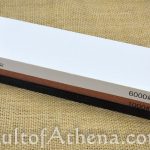
Dual Sided Corundum Whetstone / Sharpening Stone – 1000 and 6000 grit
In stock
$17.95
- Shipping estimated at checkout
- Every blade inspected before shipping
- 30-day returns
- Weight
- 1 lb 6.5 oz
Overview
Dual Sided Corundum Whetstone / Sharpening Stone - 1000 and 6000 grit
This Dual-Sided Corundum Whetstone can be used to hone and sharpen an existing edge on your knives, daggers and swords. It can also be used to sharpen the edges on tools such as chisels, scissors, hooks and gravers.
The dual sided whetstone has 1000 grit on one side and 6000 grit on the other - use the 1000 to get your edge into form and then you can use the 6000 grit for fine honing on an an edge that is intended to be sharp and thin. Included is a rubber-like gel base to keep your sharpening stone rooted to your working surface while in use.
Whetstones are available in a variety of grits to suit different needs:
Rougher grits rated at less than 1000 are typically used to repair blades with chipped edges or nicks. They are good at removing and equalizing spots of damage. They can also be used as the first step to sharpening the edge on an exceptionally dull blade, but should be used sparingly due to the ability of these stones to remove excess material if used without caution.
A 1000 grit stone is an excellent all-rounder for the starting stages of basic sharpening on a dull blade and a good starting point to sharpening the edge on an undamaged blade. They should not be used excessively, because they can potentially remove too much edge material if used beyond beginning stages.
Grits in the 2000 - 3000 range can be used on blades which an owner wishes to sharpen regularly and keep an edge in good order. Higher grits in the 4000-6000+ range are excellent for honing and refining an edge to a keen degree of sharpness, but care must be taken not to sharpen an edge beyond its intended use. Increasing sharpness comes with thinner edges, but an edge that is too thin for its application is easily damaged. High end refining grits may be suitable for knives which are used for routinely cutting soft objects, but they may become damaged if in contact with harder objects or if used with greater force and pressure.
For example - a fine grit of 4000 to even 8000 is suitable for a kitchen knife used to cut vegetables and fruits, but 3000 is the maximum edge grit for a knife used to de-bone meat as an edge that is too thin would bend and roll in even moderate contact with the harder bone material.
A variety of whetstones with a range of grits are available on our site and can be found via thumbnail links on this page under the also available section.
Please Note: This product is intended for maintaining and sharpening an existing edge on a blade. It is not intended to create an entirely new edge bevel on an unsharpened or a thick blunted blade. It is also common for there to be some stains on the top of the stone. This is cosmetic blemishing and does not affect its utility.
Specifications
Every measurement that matters
- Weight
- 1 lb 6.5 oz
- Country of Origin
- China
- Dimensions
- 7'' X 2 5/8'' X 1 3/16''
Reviews
What collectors are saying
Q&A
Questions from the community
Q What are the two grits on this stone used for? Common Question
One side is 1000 grit, which is good for bringing a dulled edge back into form or starting the sharpening process on an undamaged blade. The other side is 6000 grit, used afterward for fine honing to bring that edge to a keen, polished finish.
Q Can this stone be used to grind a brand new edge onto a blunt or unsharpened blade? Common Question
This stone is built for maintaining and restoring an edge that already exists, not for cutting an entirely new edge bevel into a thick or unsharpened blade. For routine touch-ups and honing on knives, daggers, and swords, the 1000/6000 combination covers the full range from basic sharpening to fine polishing.
Q What is the black base underneath the stone? Common Question
It's a rubber-like gel base that the stone sits in while you work. It grips the work surface so the stone stays put during sharpening instead of sliding around.
Q What material is the stone made of? Common Question
It's a corundum whetstone, a mineral abrasive commonly used in sharpening stones for its durability and consistent cutting action across both the 1000 and 6000 grit sides.
Q I see some discoloration on top of the stone, is that normal? Common Question
Yes, light staining on the top face is common with this stone and is a surface blemish only. It has no effect on the stone's sharpening performance.
Q What size is this whetstone? Common Question
It measures 7'' x 2 5/8'' x 1 3/16'' and weighs 1 lb 6.5 oz, a comfortable size for working the edge of knives, daggers, and swords by hand.
Q Is this stone only for swords, or can it sharpen other tools too? Common Question
It handles knives, daggers, and swords, and also works on tools like chisels, scissors, hooks, and gravers. The 1000 grit side handles the initial sharpening work while the 6000 grit side refines the edge for a finer finish.
Q How should I care for this stone between uses? Common Question
Rinse off any metal filings and grit residue after use and let the stone dry fully before storing it, since trapped moisture can affect the surface over time. Keep it in a dry spot along with the rubber base, and avoid leaving it submerged or wet for extended periods.
Often paired together
No reviews yet. Only logged in customers who have purchased this product may leave a review.