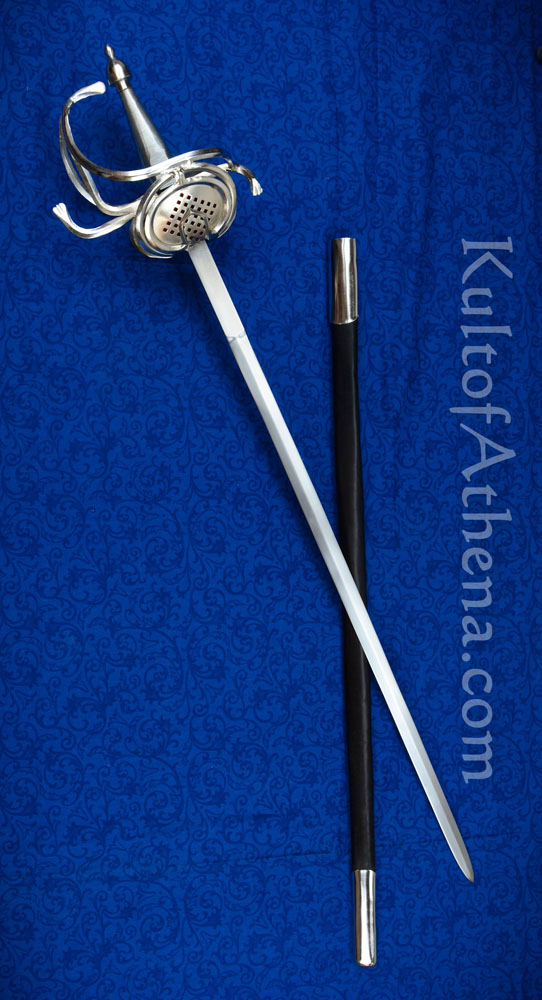
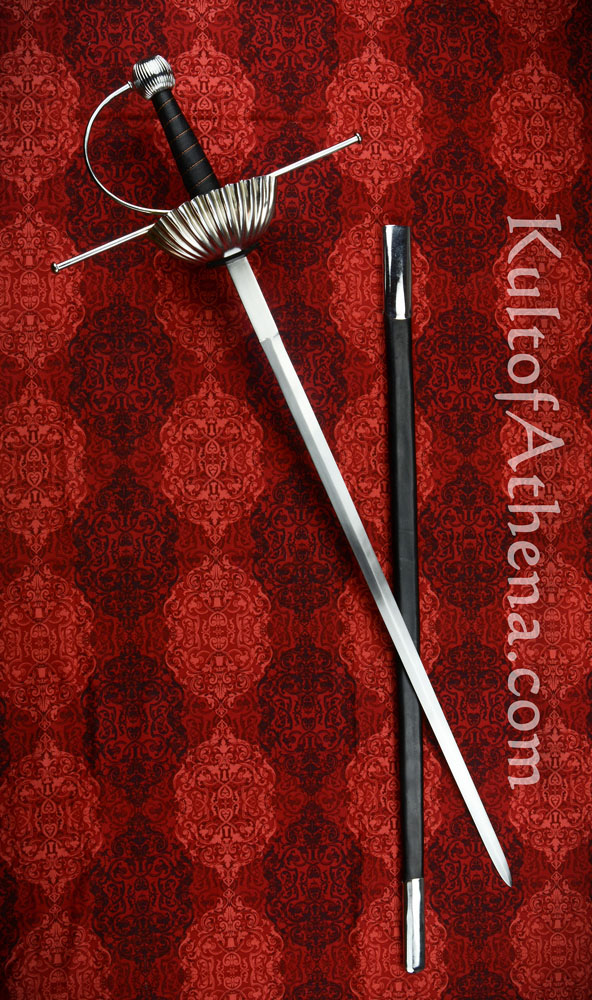
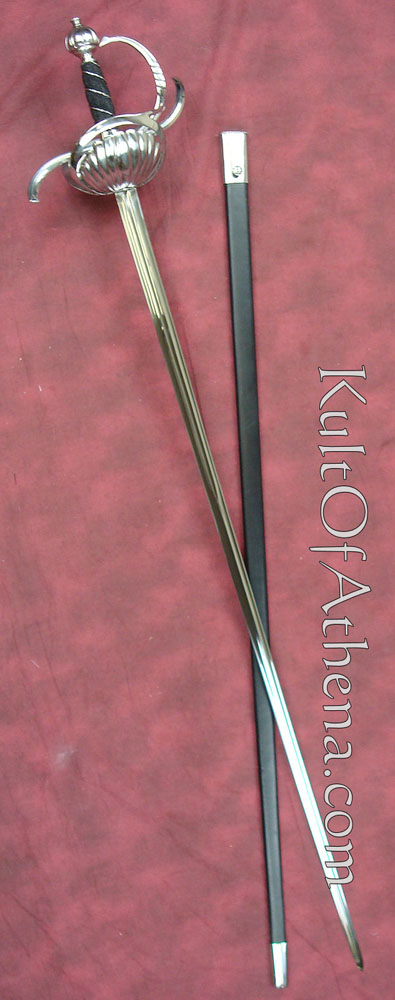
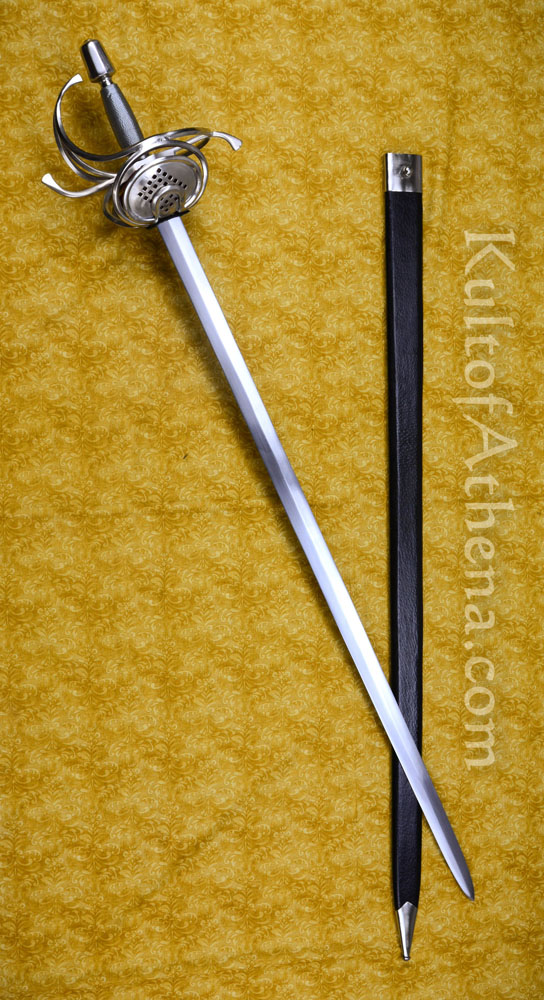
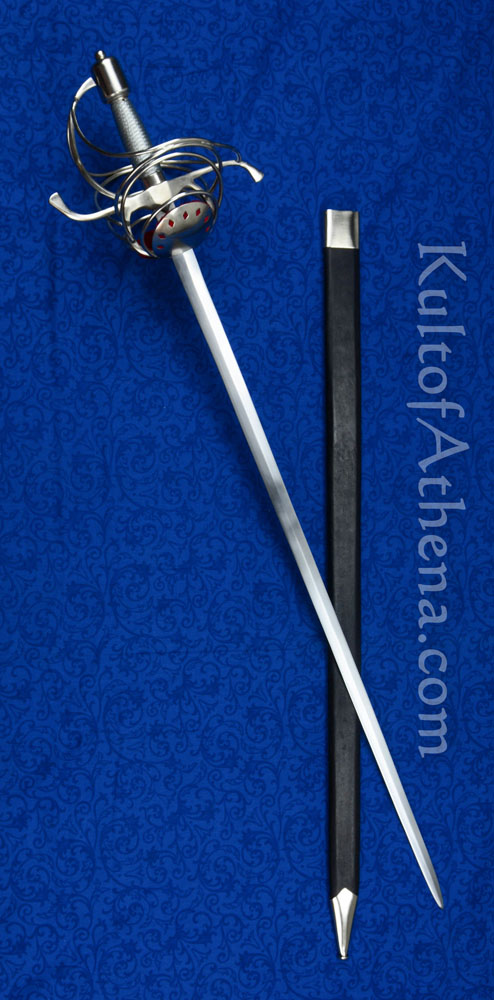
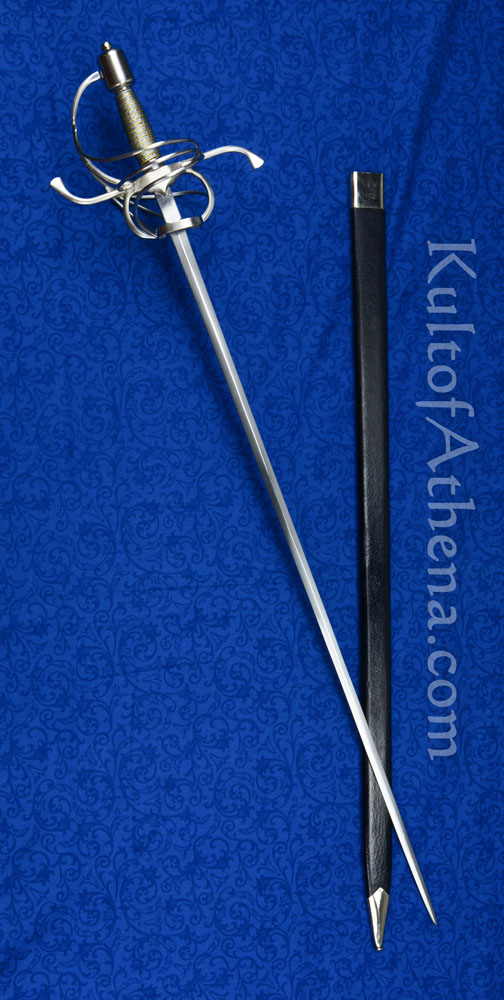
With its graceful, artistic lines, the rapier has always been a romantic symbol of the Renaissance. The reality is that the rapier is a very deadly hand-to-hand combat weapon, perfectly suited for the swift moves of the duelists of the day.
The Deschaux Rapier features an unsharpened carbon steel blade. The grip is made of bone, while the guard and pommel are steel. Includes a leather scabbard with steel accents.
The rapier was the Renaissance swordsmith’s response to demand for a light, civilian weapon that could be used in tight alleys, urban streets and duels. Though commonly associated with nobles, the rapier was used by men of all classes. It is a blade design given almost wholly to thrusting attacks – ideal for tight spaces. Long and slender, the blade in conjunction with good thrusting technique had plenty of reach to keep the foe at bay. The thrusting attack, while creating wounds not as outwardly impressive as slashing weapons, were usually the more dangerous, and fatal of the two. Even a wound of a few inches was difficult to treat and critical organs lie not far beneath the skin.
These qualities further emphasized the swordsman’s need for timing and skillful strikes for little strength was needed to make a killing thrust to an unarmored enemy with the rapier – thus its contemporary swordsmanship schools emphasized these qualities. Rapier fighting however, was not just timing and distance control, for its manuals show ample evidence of more brutish grappling, kicking and hilt strikes.
This example, made by Windlass Steelcrafts, has a blade made of tempered 1095 high carbon steel with an oval cross section. The complex hilt of twisted metal fashionably protects the hand and matches the twisted wire inlaid into the similiarily twisted grip of horn. Lion and floral etchings adorn the thickened ricasso and the sword comes with a leather and steel accented scabbard.
This rapier can be stylistically paired with the Musketeer Main Gauche to create a matched sword and dagger set. Available separately (SKU 401348)
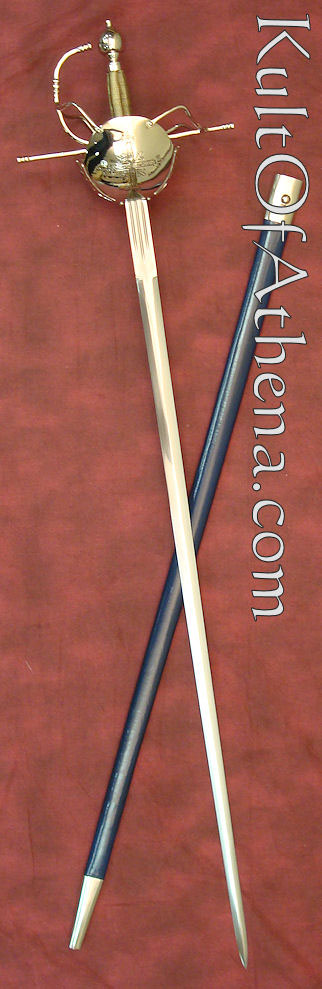
The musket, though the prime weapon of the French Musketeers, was a cumbersome firearm, both to load and fire. A good rapier was a necessary second weapon. The Musketeer rapier is fashioned after those circa 1590. The basket hilt is ambidextrous and a very effective mix of both the cup-hilt and swept-hilt styles. The grip is wood wrapped with twisted wire and the parts of the hilt are plated with gleaming nickel silver. The blade is made of well tempered high carbon steel. Includes a matching leather scabbard.
Please Note: This rapier has a metal collar around the ricasso that is often loose and it arrives in this state from the manufacturer. It is a separate component that does not affect the structural integrity of the sword as a whole.
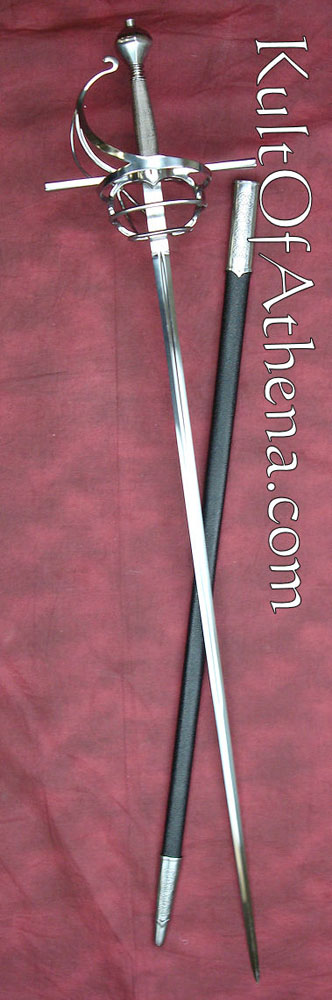
A beautifully executed 17th Century rapier with a very complex hilt and faceted pommel. The grip is hand wound with silver plated wire with woven wire rings top and bottom. The hand forged, high carbon steel, fully tempered blade features a wide fuller to lighten and strengthen it for thrusting and the heavy ricasso provides extra strength to the main stress area. Top quality, genuine leather scabbard with deeply engraved floral pattern on the throat and tip. This type of sword was deadly effective as a dueling weapon.
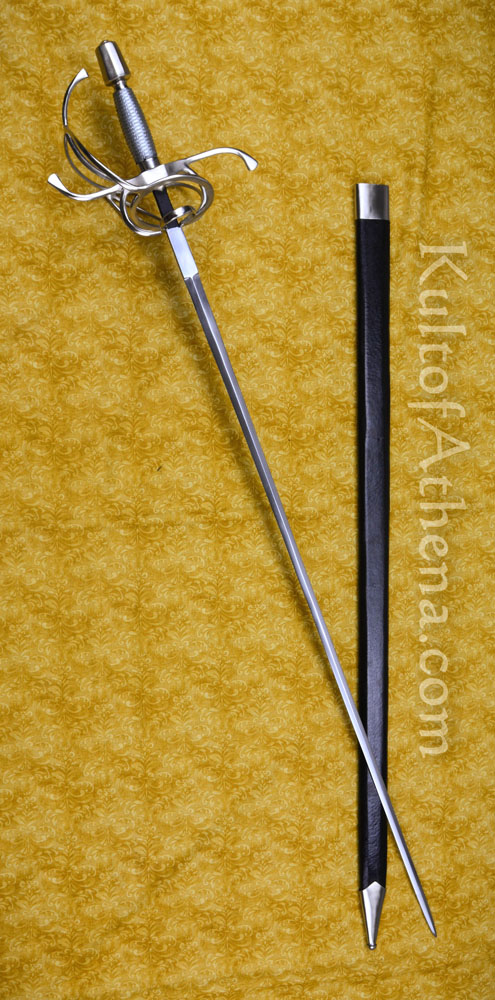
This 17th Century Swept Hilt Rapier has a slender thrusting blade forged from C60 high carbon steel; the diamond cross section of the blade imparts some stiffness to the blade to ensure it can pierce with maximum effect. The swept hilt is crafted from mild steel and the grip is wood which has been tightly bound in steel wire. The base of the blade is overlaid in black leather for an improved grip when using the finger guards above the crossguard.
The wood-core scabbard is wrapped in fitted black leather and finished with a protective steel chape and locket.
This swept-hilt Rapier has a tempered blade of high carbon steel which is mounted into a steel swept hilt. The grip is wood with a wrap of braided steel wire. The shorter blade length on this rapier makes it an agile sword that is easy to wield and its bearer does not need to fight against the leverage incurred by a longer blade against the hand. Included with the sword is a leather scabbard with a steel chape and locket.
This Flemish Pappenheim Rapier has a blade forged from high carbon steel. It is fitted to a complex hilt of steel and a clamshell guard backed in red velvet. The hardwood grip is tightly bound in steel wire.
The scabbard is crafted from leather and fitted with a steel chape and locket.
This Cup-Hilt Rapier has a blade crafted from EN45 high carbon steel. The crossguard, knuckle bar and fluted cup hilt are of steel and the pommel is stainless steel. The grip is wood with a stitched leather wrap and a braided copper wire inlay. A thick leather tab atop the cup protects it from scratches when sheathed in the scabbard. This rapier has a large hilt which will better accommodate a larger-handed person than some of the smaller-hilted rapiers on the market.
Included with the rapier is a durable leather scabbard with a steel chape and locket.
According to most historians the Rapier first appeared on the sword scene in the late 14th century and held sway in most of Europe until the late 16th century except in Spain where it endured clear into the 18th century. The reason for its long reign as the civilian weapon of choice for self-defense and dueling can be tied to its two major advantages.
First its long, slim, double edged blade was ideal for delivering point oriented blows at a great distance while still being able to deliver a stinging cut. And secondly, its continually evolving hilt of rings, bars, quillions, shells, and eventually, an intricately chiseled cup offered excellent protection (especially now that the armored gauntlet had been abandoned) and shed, caught or deflected blows at the sword hand and forearm with great aplomb.
Sadly, while never proven ineffective or obsolete, the rapier eventually succumbed to the dictates of fashion and gave way to the emerging small sword. Happily Cold Steel has chosen to revive the Rapier with their own interpretation designed by Dave Baker. The long, narrow 1055 carbon steel blade is fully sharpened and beautifully polished with a single wide fuller at the forte to assure perfect balance. The hilt also reflects the best in craftsmanship and materials fashioned from stainless steel featuring a classic ribbed shell and multiple bars, quillions and knuckle bow for unparalleled hard protection. The grip itself is made of wood covered with rich black ray skin and decorative wire and terminates in a heavy ribbed pommel that serves as a counter balance to our Rapier’s long blade. Includes a leather scabbard with steel fittings.
This Pappenheimer Rapier has a transitional-style rapier blade that is forged from C60 high carbon steel; the wider blade allows it to be a good cutting sword in addition to a thrusting sword. The complex and protective Pappenheimer hilt is crafted from mild steel and its grip of wood is tightly bound in twisted steel wire.
The pierced shell guard is backed by red velvet and a small, black felt tab is fitted atop the guard to protect it from scratches when in contact with the scabbard.
This 17th Century Pappenheimer Rapier has a slender blade forged from C60 high carbon steel. It is fitted to a complex hilt of mild steel. The wood grip is bound in steel wire and the shell guard is backed with red velvet.
The companion scabbard of the sword is crafted from wood and is finished with a tightly fitted wrap of leather and a protective chape and locket of steel.
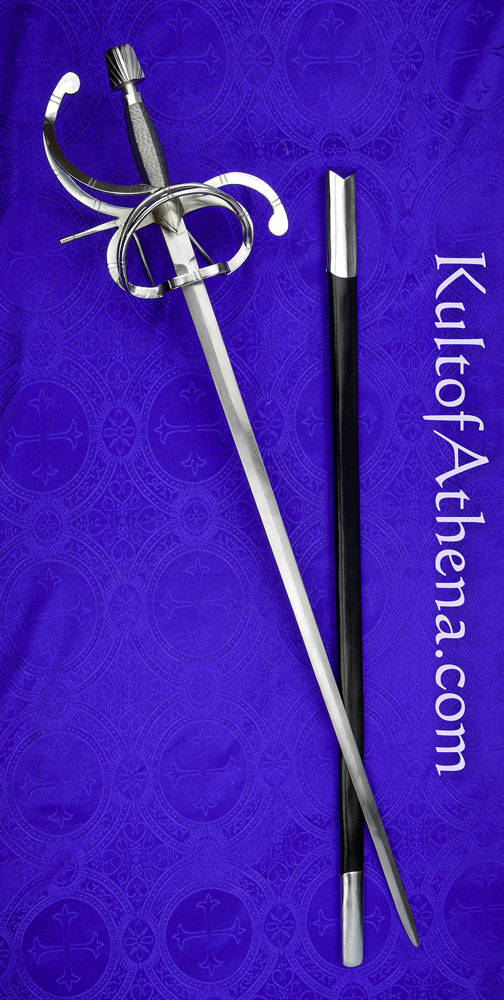
This Early 17th Century German Rapier has a piercing blade forged from C60 high carbon steel; the blade has a diamond cross section which gives it some stiffness to optimize its thrusting ability.
The swept hilt is crafted from mild steel and the wooden grip is tightly bound in spiralled brass wire interspaced with twisted steel wire. The wood scabbard is overlaid in black leather and fitted with a steel chape and locket.
Order Status
You will receive an email notification, including tracking information, when the order ships. If you ordered an in-stock item, please reach out to us only if you have NOT received a shipment notification after 7 business days.
We prioritize quality over speed.
Our shipment times include an amount of time for us to inspect and then appropriately package and protect your purchase before we ship. We are proud to be famous for our brown-paper protective wraps which help your purchase arrive in excellent condition.
Shipment times will vary due to the stock status of an item and whether you included other services, such as sharpening, in your order.
If an item is in-stock, we aim to ship within 7 business days of your order. If you have added sharpening, it may add up to an additional 7-10 business days.
Our items that are listed as Usually Ships in One to Two Weeks normally ship within 10-14 days.
Thank you for being a valued customer!
Kult of Athena Team
Local Pickup
After you place your order, we’ll work on getting it ready as soon as we can. We know you’re excited to get your new items, but please make sure you wait to hear from us before you head over to our facility for pickup. We don’t want you to show up before your order is ready and have to wait.
You’ll receive a call or an email from us as soon as your order is ready for pickup.
See you soon!
Kult of Athena Team
Deposits
Take advantage of our deposit option and pay only a deposit (+shipping) at this time. The cart will process this as a normal order and calculate your shipping costs so you know what to expect. When the item is available to ship we will contact you for the balance.
Please note: this deposit is non-refundable. Turn around time is an estimate and can vary depending on the manufacturer’s given work load.
This option is not for in stock items, it is only for special orders with long turnaround times. If you do order something marked as in stock, the stocked model will not be held for you. A new special order with the listed turnaround time will be started for you instead, to allow you the time to pay off the full price.
Unsharpened
Unsharpened edges will be thinner than a “blunt” edge, but will not offer any cutting ability. They will typically taper towards an edge, but then stop short.
Sharpening Service
Overview
Our sharpening service will provide a good serviceable edge on the blade. The result is typically “very sharp” with a small secondary bevel and a bit of an “apple seed” profile. The resulting edge is somewhat dependent on the particular blade. Some blades will take and hold sharper edges than others and the thickness of the blade will determine how wide the bevel will need to be. We adjust the angle of the edge to suit the specific blade and attempt to get as close to a bevel-less edge as possible without marring the surface of the blade.
The Sharpening Process
The sharpening service is done with a belt sander. The process involves many passes with sanding belts of various grits. The blades are rested between passes to prevent them from becoming hot and damaging their temper. By default we will sharpen as much of the blade as possible including any false edges if appropriate. If you have a different preference, feel free to make that request in the special instructions at check out. We can sharpen only the last half or third of an edge, for example. Our sword sharpening expert has personally sharpened several thousand swords at this point, so will provide you with a professional service.
What the Service is Not
The resulting edge will be “sword sharp” not razor sharp. Our goal is to provide you with a usable edge for cutting practice that will hold up to some use and not require constant re-sharpening. In other words, we intend to provide you with a serviceable weapon, not a personal grooming implement. The service will not provide a completely bevel-less edge. To create that type of edge will necessarily scratch up the blade surface and we lack the machinery and time to provide a full re-polishing of a blade’s surface. A service of that nature would be significantly more expensive as a great deal more time would be required. We do not offer this type of service at this time.
Disclaimer
We make no guarantee that the resulting edge will meet with your expectations. Every blade is different and some will take and hold a sharper edge than others, due to the blade material, heat treatment or geometry. Some customers can also have incorrect assumptions about sword sharpness and improper expectations as a result. All we can say for sure is that the resulting edge will be sharper than the default edge, in most cases, significantly so. We can not provide any refunds for the service once it has been completed, so consider it to be provided “as is”. That being said, if you are unhappy with the product for any reason, we do still allow you to return the item for a full refund, including the sharpening costs under our normal return policy. This does not apply to special sharpening requests, for example if we sharpen something specially for you that does not normally list that option on our site. The vast majority of our customers are happy with the results of the service, so as long as you keep the above mentioned in mind, we are confident you will be pleased with the results as well.
Grade
Blemished
A factory blemished model will have small cosmetic defects but no issues that will affect its function. Examples include, small surface scratches, scabbard dents or cracks, minor blade pitting, etc. Larger issues like blade chips, cracks, warps or anything else that will affect performance will not be included with these. Please note that we do not keep track of every specific minor blemish, so please do not contact us asking for details, we will not have them available. We are offering these items at a further discount for customers who are not overly concerned with cosmetics and intend to put them to some use.
Munitions Grade
A munitions grade item is not up to our normal high standards. Munitions grade items will typically have various bends or twists in the blades, basically rendering them as 2nds quality. These items are still a great choice for collecting and re-enacting and functional pieces will still be functional. Please keep this in mind when ordering.
Munitions Grade
This “Munitions Grade” item is not up to our normal high standards. Munitions grade items will typically have various bends or twists in the blades, basically rendering them as 2nds quality. These items are still a great choice for collecting and re-enacting and functional pieces will still be functional. Please keep this in mind when ordering.
Country of Origin
“Country Of Origin” refers to the coutry where the product was manufactured. This is not to be confused with the “Culture” spec. For example, a culturally “Japanese” Sword could be made in India, a culturally “German” sword could be made in the US or a culturally “Indian” sword could be made in China. The historic “culture” associated with a particular sword and the country a reproduction is currently being made in, are two separate things and should not be confused.
Manufacturer
As you would imagine, the “Manufacturer” spec refers to the brand or company the item is made by. Not all products will have a manufacturer listed. Some products do not fall under a specific brand.
Culture
The “Culture” spec will denote if the item is associated with a specific group of people, conflict or geographic area. For example, “Viking”, “Crusader”, “Pirate”, “Indian” “WWII”, and so on. Please note that many items will not fall into a specific culture like this and were used by many peoples or across many time periods.
Class
The “Class” spec can have four possible values:
Battle Ready – For functional weapons
Sport Combat – (also known as Stage Combat) For blunted fighting weapons
Decorative – For display only weapons
LARP – For Foam fighting weapons
P.O.B.
P.O.B. stands for Point Of Balance, this is measured in inches from the hilt down the blade. It refers to the point on the blade where the sword achieves a perfect balance. A number of 0” would balance exactly at the guard, while a negative number will have a POB in the hilt itself. In theory a sword with a POB of 0” is perfectly balanced. In practice however, there are many reasons why you may not want this for a particular sword. A POB of 3”- 5” usually results in a well balanced sword, but does depend on the type of sword. In general, a low POB results in good point control well suited to a thrusting blade, while a higher POB adds impact to a cleaving blade. A very high POB will result in a sword that feels heavier than it actually is and is difficult to wield.
Please note: Due to the hand made nature of these items, all specs should be considered as approximates. This info is provided to give you a good idea of the product being presented, the one you receive may vary from the specific one we took measurements of.
Pommel
The Pommel entry refers to how the pommel, and usually by extension the whole sword, is held together. Possible values include “Peened” where the blade tang goes through the pommel and is hammered flat at the end, Threaded” where the end of the tang has threads and the pommel is screwed on, or “Nut” where the tang goes through the pommel and is secured by a separate threaded nut at the end.
Thickness
“Thickness”, not to be confused with a blade’s “Width” is measured in millimeters on the blade where it first leaves the hilt and will refer to the thickest portion. For example the back edge on a katana or the mid section on a diamond shaped blade. Sometimes you will see two entries here, in that case it is usually because the blade is “distal tapered” meaning that it gets thinner towards the tip. The second measurement is taken approx. 1” from the tip.
Please note: Due to the hand made nature of these items, all specs should be considered as approximates. This info is provided to give you a good idea of the product being presented, the one you receive may vary from the specific one we took measurements of.
Width
On blades, the “Width” is measured in millimeters and is taken where the blade leaves the hilt. A second measurement is provided when a blade widens further down, such as in a leaf shaped blade. The second measurement is taken at the blade’s widest point.
Please note: Due to the hand made nature of these items, all specs should be considered as approximates. This info is provided to give you a good idea of the product being presented, the one you receive may vary from the specific one we took measurements of.
Edge
The “Edge” spec will tell you about how sharp a blade is. Possible values could be “Rebated” meaning the edge is intentionally thickened for safety, “Blunt” meaning the edge is fairly thick with little to no taper, ‘Unsharpened” which would taper to the edge but stop short of having any real cutting ability, “Slightly Sharp, Moderately Sharp , Sharp, or Very Sharp” Sharp or Very Sharp are considered good for cutting swords. Moderately Sharp is close, but may need to be touched up to get the best performance. A common misconception is that swords should all be “razor sharp”. However for reasons we won’t get into here, this is not the case.
Please note: Due to the hand made nature of these items, all specs should be considered as approximates. This info is provided to give you a good idea of the product being presented, the one you receive may vary from the specific one we took measurements of. The Edge ratings in particular are somewhat subjective and each blade can vary. Consider this as a general guideline only.
Weight
The “Weight” spec refers to the item itself and does not include any packaging or accessories. For example, it would be the weight of a sword not including a scabbard.
Please note: Due to the hand made nature of these items, all specs should be considered as approximates. This info is provided to give you a good idea of the product being presented, the one you receive may vary from the specific one we took measurements of.
Overall Length
As you’d imagine, “Overall Length” is the full length of the item in question. It is the length of the main item itself, not including any accessories. For example, this measurement for a sword would be for the sword itself, from the tip of the blade to the end of the pommel. This measurement will not include any scabbards, sheaths, boxes etc.
Please note: Due to the hand made nature of these items, all specs should be considered as approximates. This info is provided to give you a good idea of the product being presented, the one you receive may vary from the specific one we took measurements of.
What is "Battle Ready?"
Swords marked as “Battle Ready” are made to a higher standard than your average display weapons. The blades are usually made of carbon steel, as opposed to the more brittle stainless steel and feature longer and stronger tangs.
“Battle Ready” does not necessarily mean the blade is sharpened, this depends on the manufacturer. Some sell them sharp like Cold Steel, some dull like Windlass Steel Crafts, and some do both like Hanwei. So if you need to know if it is sharp or not and it is not mentioned in the description, just ask.
In general “Battle Ready” swords are functional weapons that will live up to actual combat usage. They are closest to historic examples in the fact that when properly sharpened they can cut as designed. However, “Battle Ready” does not mean indestructible. Any sword can be broken. Use common sense with your sword, and it will last for generations. A sword being listed as “Battle Ready” does not constitute a guarantee that it will withstand any abuse you can throw at it. “Battle Ready” swords are not designed for blade to blade type combat, you will want to select “Stage Combat” swords for this activity.
What is "Sport Combat?"
Swords listed as “Sport Combat” (also known as “Stage Combat”) are specifically designed for combat reenactment, stage and film fights, and other activities where they will be hit edge to edge together.
Using a sword in this capacity is very different than how a sword would have been used historically, and as a result the sword must be made differently. Sport combat swords feature extra strong tangs and thick blades with thick edges. Sport combat swords will generally weigh more than a “Battle Ready” equivalent and are not made to be sharpened.
Swords listed as “Sport Combat” will hold up to a fair amount of usage, but will wear out with time. No sword is indestructible, and “Sport Combat” swords are no exception.
Blade Length
On a sword, knife or dagger, The “Blade Length” spec is measured from the tip of the blade to where the blade enters the hilt, this will include a ricasso portion if present. For katanas, this measurement includes the habaki.
On a spear it is a measurement of the edged portion and does not include the socket. On an axe, it is a measurement of the axe edge itself, in a straight line from point to point.
Please note: Due to the hand made nature of these items, all specs should be considered as approximates. This info is provided to give you a good idea of the product being presented, the one you receive may vary from the specific one we took measurements of.